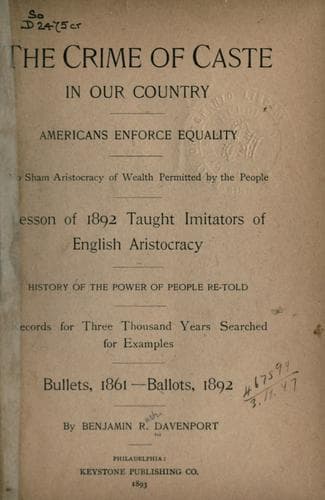
The Crime of Caste in Our CountryDavenport, Benjamin Rush
History
The Crime of Caste in Our Country
Davenport, Benjamin Rush
Social problems; United States -- Social conditions -- 1865-1918
Such was the land-holding, slave-holding, office-holding aristocracy,
against which the first directly and avowedly antagonistic movement was
that of the Republican party. Young and weak in its first Presidential
contest of 1856, the new organization gathered strength steadily; and
when, on April 29, 1860, the Democratic Convention at Baltimore was
rent asunder by the Secessionists, it became clear that the Republicans
would have to face the threatened disruption of the Union.
The Republican Convention met at Chicago and chose, in preference
to the able and experienced Seward, Abraham Lincoln, of Illinois, a
man who, then comparatively unknown, was to take rank as perhaps the
noblest and greatest of all America’s sons.
Lincoln, when asked for an account of his boyhood, said that it
might be summed up in Crabbe’s famous line: “The short and simple
annals of the poor.” J. G. Holland thus reviews the career of the
man who led the struggle that began in 1860: “Born in the humblest
and remotest obscurity, subjected to the rudest toil in the meanest
offices, achieving the development of his powers by means of his own
institution, he had, with none of the tricks of the demagogue, with
none of the aids of wealth and social influence, with none of the
opportunities for exhibiting his powers which high official position
bestows, against all the combinations of genius and eminence and
interest, raised himself by force of manly excellence of heart and
brain into national recognition, and had become the local center of
the affectionate interest and curious inquisition of thirty millions of
people.”
To the end of his life, Lincoln was the very incarnation of democratic
simplicity. He was never at home in a drawing-room; he never could
dispose gracefully his hands and feet--appendages whose size was
proportionate to his huge stature. After his nomination for the
Presidency, he used to answer his own bell at his little house in
Springfield, Illinois.
The people’s man of 1860, ABRAHAM LINCOLN! The pulse of patriotism
quickens at the pronunciation of the name. The people’s plain Abe
Lincoln; one of them, a commoner, of them, with them, like them.
To foreign nations, he may have appeared as “President Abraham
Lincoln, Chief Magistrate of the United States.” He may have been
“Commander-in-Chief of the Army and Navy,” in the minds of his
subordinates in those two important branches of his administration
from ’61 to ’65. History may record him as the “wise, able, and
philanthropical.” But his memory will last enshrined in a temple more
lasting than bronze or stone--the hearts of the people.
Public-domain text, read in full here on John Shaqi.
Reviews
Reviews
No reviews yet
Be the first to share your thoughts on this work.
Elsewhere in the archive
Join the Discussion
Join the discussion
Sign in to leave a comment or review.
Sign InorCreate an account