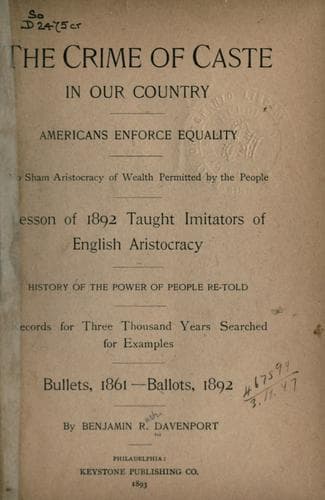
The Crime of Caste in Our CountryDavenport, Benjamin Rush
History
The Crime of Caste in Our Country
Davenport, Benjamin Rush
Social problems; United States -- Social conditions -- 1865-1918
“The Southern planter,” says a member[2] of one of the old landed
families, who is now well known as the self-appointed manager of
New York society, “was a born aristocrat. He had literally as much
power in his little sphere as any old feudal lord. His slaves were
the creatures of his caprice and pleasure. The work of their hands
supported him, gave him his position and influence. I have lived on a
plantation with twelve hundred slaves, all devotedly attached to their
master, evidencing as much loyalty and fealty as an Englishman to his
sovereign, and taking great pride in their master and mistress.”
The planter’s life was one of patriarchal magnificence. His
entertainments, according to the same authority, “would be appreciated
in the old Faubourg at Paris;” his wines were old and abundant; his
songs were the ballads of his historical prototype, the mediæval baron
of England:
“Lord Thomas, he was a bold forester,
The keeper of the King’s deer;
Lady Eleanor was a fine woman,
Lord Thomas he loved her dear.”
Political power within its own commonwealths was of course practically
monopolized by this land-owning caste. Of power in national politics it
wielded a tremendous share. It had taken advantage of that feature of
the Federal Constitution which, when it was first framed, Patrick Henry
attacked when he prophesied that “an aristocracy of the rich and well
born would spring up and trample upon the masses.” Outnumbered in the
House of Representatives, it had firmly intrenched itself in the United
States Senate.
In that body, up to the time just before the war, when it was no longer
possible to create a new Southern State to offset each Northern
State, it held half the seats and votes--a position that gave it
complete control of all Presidential nominations to office. Through its
possession of this unassailable veto power on appointments, it had come
to pass that, as Mr. Blaine observes in his “Twenty Years of Congress,”
“the Courts of the United States, both Supreme and District, throughout
the Union, were filled with men acceptable to the South. Cabinets were
constituted in the same way. Representatives of the government in
foreign countries were necessarily taken from the class approved by
the same power. Mr. Webster, speaking in his most conservative tone in
the famous speech of March 7, 1850, declared that from the formation
of the Union to that hour the South had monopolized three-fourths of
the places of honor and emolument under the Federal Government. It was
an accepted fact that the class interest of slavery, by holding a tie
in the Senate, could defeat any measure or any nomination to which its
leaders might be opposed; and, thus banded together by an absolutely
cohesive political force, they could and did dictate terms.”
Public-domain text, read in full here on John Shaqi.
Reviews
Reviews
No reviews yet
Be the first to share your thoughts on this work.
Elsewhere in the archive
Join the Discussion
Join the discussion
Sign in to leave a comment or review.
Sign InorCreate an account