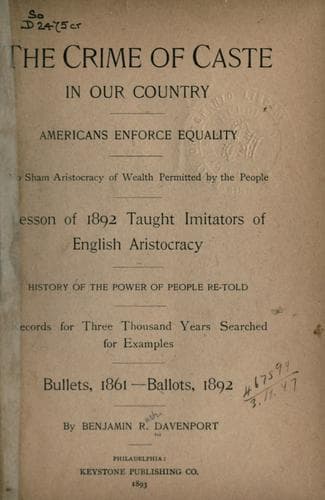
The Crime of Caste in Our CountryDavenport, Benjamin Rush
History
The Crime of Caste in Our Country
Davenport, Benjamin Rush
Social problems; United States -- Social conditions -- 1865-1918
The South sought by secession to absolve itself from the domination of
the masses. It was like the patricians of Rome seeking the Sacred Hill
to build a new city. It failed, as will ever the minority, representing
a false idea of American society and a false conception of the spirit
with which every American is imbued, do in the future. But, be it
said to the credit of the believers in aristocracy in 1860, that they
had the courage of their convictions, and they fought a manly battle
to establish that which is impossible in America. The history of the
Southerners’ sufferings and dangers, endured uncomplainingly, forms a
bright and shining exception to the conduct of the typical believer in
“caste.” Sham aristocracy, which has disregarded the rights and wounded
the feelings of the people for the past twenty-five years, that sham
aristocracy which is a direct outgrowth resulting from the suppression
of the Southern aristocracy, if tested as the Southern aristocracy
has been, would be found deficient in those qualities of courage and
determination which made even the Southerners’ false ideas respected
and respectable.
The sham aristocracy of to-day, unlike the false aristocracy of 1860,
would hire bullies, outcasts, and vagrants to do their fighting, as did
those magnificent illustrations of “caste” in our country, Carnegie and
Frick, at Homestead, and Son-in-law Webb at Buffalo.
The advocates of “caste” in 1860, the Southerners, not alone possessed
courage and determination, but, accepting the result of the conflict,
have exhibited since the days of Reconstruction that wonderful
degree of political acumen for which they have ever been famous.
Early recognizing that in their struggle for an independent national
existence, the Southern Confederacy, they had been defeated--not by
the aristocracy of the North and West, but by the Common People; that
is, the most powerful portion of the population of the Union--the
Southerner, the secessionist, the aristocrat of 1860, submerged himself
in the ocean of the Common People, the great majority, the democracy!
The Secessionist, who opposed Abraham Lincoln’s administration in 1860
and used bullets to express his opposition in 1861, had firm conviction
carried to his hesitating heart by the events that transpired between
1861 and 1865, that the “Common People”--the majority--must rule;
and that with the freeing of his slaves he had lost the only possible
foundation upon which he could rest his claim of social superiority
in this country. Therefore, as the wise man that he has demonstrated
himself to be, the aristocrat of 1860 has become the most earnest
and patriotic member of a broad democracy in 1892; realizing from
experience that upon that rock alone he can build the edifice of
prosperity in his section of the country; also realizing from a sad
experience that the Common People, democracy (though it was called
Abraham Lincoln’s Republican party), was the crag upon which his bark
Public-domain text, read in full here on John Shaqi.
Reviews
Reviews
No reviews yet
Be the first to share your thoughts on this work.
Elsewhere in the archive
Join the Discussion
Join the discussion
Sign in to leave a comment or review.
Sign InorCreate an account