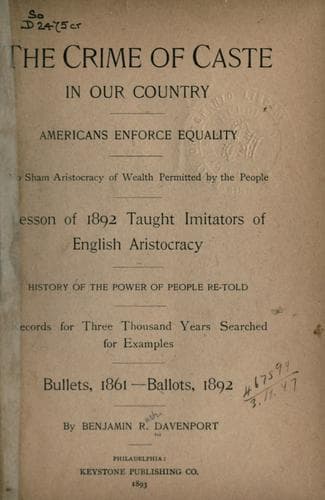
The Crime of Caste in Our CountryDavenport, Benjamin Rush
History
The Crime of Caste in Our Country
Davenport, Benjamin Rush
Social problems; United States -- Social conditions -- 1865-1918
of Secession was shivered in 1865.
[Illustration: ANDREW JACKSON.
The “People’s” President, 1828.]
FOOTNOTE:
[2] Of course I mean Ward McAllister. This is not from his book, but
from a recent article of his published in the New York _World_.
CHAPTER XI.
ANDREW JACKSON, 1828.
Jackson was in truth a popular idol. Hickory poles, the emblem of
devotion to “Old Hickory,” stood in every village throughout almost
every State, and at the street corners of many a city. In his own
Tennessee, less than three thousand votes were cast against him in the
entire State, and in many precincts he received every ballot.
The story is told of a stranger who visited a Tennessee village on the
afternoon of the election, and found its male population turning out
with their guns, as if for a hunt, and in a state of great excitement.
On inquiring what game they were after, he learned that they were
starting in pursuit of two of their fellow-citizens who had had the
audacity to vote against Jackson, thereby preventing the village from
casting a solid vote for “Old Hickory.” The miscreants had avoided a
tarring and feathering only by taking to the woods.
The result of the campaign was a triumph for Jackson. New England was
the stronghold of Adams, who received all its electoral votes except
one from Maine. The National Republicans also carried New Jersey and
Delaware, and New York and Maryland were divided. Every other State
declared solidly for Jackson, whose total vote was 178, to 83 for Adams.
During that campaign, the same question appeared on the surface as
that presented in the campaign of ’92. The Whig party represented
apparently higher tariff, and the Democrats were opposing the increase
of duty; but the fact remained that John Quincy Adams represented the
aristocracy of New England, and the Whig Party had become encrusted
with the same false stucco of “caste” that concealed the merits,
worth, and virtue of Lincoln’s Republican party in 1892. E’en the most
wonderful orator that America has ever produced, the great and honored
Daniel Webster, with all of his personal magnetism, magic of speech,
and logic of argument, could not boost the aristocrats of the Whig
party into power; even though the bill for a higher tariff had passed,
the cry was kept up, and was made to appear as one of the issues of the
campaign of 1892.
Public-domain text, read in full here on John Shaqi.
Reviews
Reviews
No reviews yet
Be the first to share your thoughts on this work.
Elsewhere in the archive
Join the Discussion
Join the discussion
Sign in to leave a comment or review.
Sign InorCreate an account