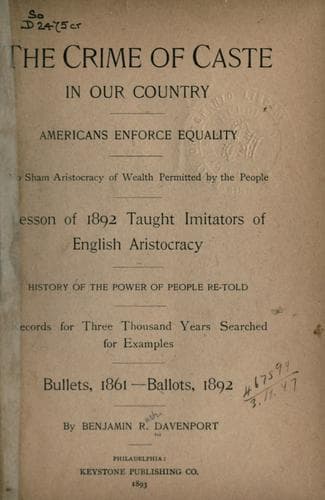
The Crime of Caste in Our CountryDavenport, Benjamin Rush
History
The Crime of Caste in Our Country
Davenport, Benjamin Rush
Social problems; United States -- Social conditions -- 1865-1918
That little dot on the map of Europe, situated among the Alps, called
Switzerland, has always formed an attractive and pleasing object to
lovers of freedom and equality. Surrounded by powerful neighbors, the
mountaineers of these little cantons seem to have imbibed, with the
purer air of heaven in which they live on the mountains, that degree of
stern courage, determination, and love of liberty which enables them to
resist the pressure of the great nations by which they are surrounded.
Switzerland, like the wedge of steel, tempered by the spirit of
republicanism, has formed one point of pressure which the monarchies
around her have been unable to resist. The love of liberty with which
the Swiss are endowed, and their hatred of “caste,” are best typified
by “The Gray Leaguers” and their story:
In the green valleys of Eastern Switzerland, on almost every hill
that juts out from the gray mountain walls of the Alps and commands
the fertile fields and villages of the upper Rhineland, there stands
a ruined castle. And in that castle, in the early Middle Ages,
there dwelt some little local princeling who lorded it with almost
unquestioned power over the peasantry around him.
These feudal nobles had held sway, with no right save that founded on
might, for generations, before the subject peasants, weak, scattered,
and resourceless, were at last driven by the intolerable arrogance
of this dominant “caste” to combine for mutual defence. Some of the
leaders of the movement met in the little hillside chapel of St. Anna,
still standing near the town of Truns, in March, 1424, and took solemn
oaths to respect their own and all the people’s rights, and to wage war
upon those who would not respect them.
Johann Caldar--a name revered in his district as is that of William
Tell in the scenes of his legendary exploits--gave the signal for
the first attack on the oppressors. Caldar dwelt in the upper Rhine
valley, not far from the baronial castle of Fardun. The Lord of Fardun
entered the peasant’s cottage one day at noontide, and in wanton token
of contempt spat into the soup that was boiling for the midday. Caldar
seized him, and crying, “Eat the soup thou hast seasoned!” thrust his
head into the pot, and held it thus until he was choked. Then he went
forth to bear over mountain and valley the banner of a revolt that
forever annihilated the nobles’ tyranny and left their strongholds in
ruins.
For three centuries and a half the Gray Leaguers, as the victorious
peasants called themselves, met every tenth year in the chapel of St.
Anna, where their first oaths had been taken, and renewed the pledge of
popular liberty. At length their territory became the fifteenth canton
of the Swiss Republic, still retaining, as it does to-day, its old
name--the Grisons, as it is in French.
Public-domain text, read in full here on John Shaqi.
Reviews
Reviews
No reviews yet
Be the first to share your thoughts on this work.
Elsewhere in the archive
Join the Discussion
Join the discussion
Sign in to leave a comment or review.
Sign InorCreate an account