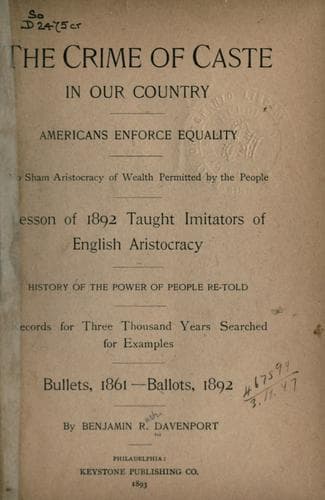
The Crime of Caste in Our CountryDavenport, Benjamin Rush
History
The Crime of Caste in Our Country
Davenport, Benjamin Rush
Social problems; United States -- Social conditions -- 1865-1918
Unfortunately, however, the uproarious hordes were without other
leadership, and lacked discipline and effective weapons. They gathered
in throngs of from 5,000 to 10,000, and ran hither and thither, with
clubs, stones, and perhaps a few firearms, burning castles, destroying
monasteries, plundering villages, towns, and cities, and committing
ferocious outrages. Before the regular armies, these multitudes were
scattered like chaff in the hurricane. They fought with the fury and
courage of tigers, but it availed them nothing; they were routed,
dispersed, and massacred, and effectually crushed in a few months.
Münzer was tortured and beheaded. Von Berlichingen was placed under
the ban of the empire by Maximilian I., his exploits serving as the
subject of Goethe’s drama of “Götz von Berlichingen.”
While unsuccessful, this uprising of the peasants demonstrates that
the inherent love of liberty has a place in the hearts of the German
race, and should furnish to Emperor William a warning note that there
may be a point where, in spite of the Germans’ love for Fatherland,
and pride in the glories achieved by the Empire, they may resent
expression of autocratic authority on the part of their Emperor.
When the German becomes an American citizen--and there are no better
citizens of America than the Germans--the spirit of equality, which
has lain dormant in the Teutonic blood for centuries, immediately
asserts itself. Under the wise guidance of Bismarck, German unity was
made possible, and the glory won by united Germany has influenced
the Germans in Europe to submit to heavy taxation, and the continued
assumption of social superiority; but the time is rapidly approaching,
which it would be well for Emperor William to consider, when the German
people of Europe will exhibit the same love of liberty and equality
that the children of the German race exhibit as citizens of the
American Republic. It is to be hoped that the German empire will not
sustain the severe shock in the latter part of the nineteenth century
by which the whole social system in the kingdom of France was rent
asunder, in the latter part of the eighteenth century.
CHAPTER XVII.
SWITZERLAND, 1424.
Public-domain text, read in full here on John Shaqi.
Reviews
Reviews
No reviews yet
Be the first to share your thoughts on this work.
Elsewhere in the archive
Join the Discussion
Join the discussion
Sign in to leave a comment or review.
Sign InorCreate an account