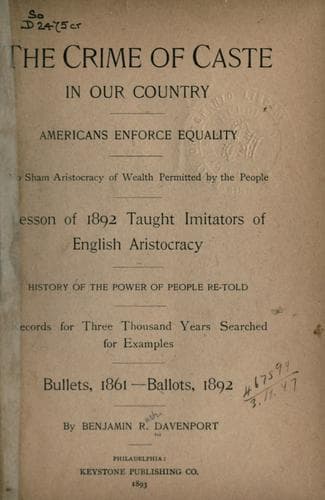
The Crime of Caste in Our CountryDavenport, Benjamin Rush
History
The Crime of Caste in Our Country
Davenport, Benjamin Rush
Social problems; United States -- Social conditions -- 1865-1918
As the positive and negative poles of an electric battery, or as like
and unlike attract, there has long been a strong friendship between
Russia and our country. The two represent the antipodes of government.
From the period of the appenages (small, petty States, 1054-1238) the
enmity has been in a state of smothered or open revolt. It was overrun
by the fierce Mongols and held under their iron yoke from 1238 to
1462. During that period Moscow and many other cities were burned and
the country devastated.
Ivan III. (1263), during his reign of 43 years, did much to consolidate
the empire, and introduced the knout as an agent of civilization.
Ivan IV., known as Ivan the Terrible, was a ferocious monster
(1533-1584), who first assumed the title of Czar (a Slavonic form of
the Latin Cæsar), committed numerous atrocities, and killed his eldest
son by a blow in a fit of anger.
Peter the Great (1689-1725) was remorseless in his punishment of those
who revolted, as in the case of the streltzi; the rebellion of the
Cossacks of the Don; that of Mazeppa, the hetman of the Little-Russian
Cossacks; he inaugurated serfdom, and tortured his own son, Alexis, to
death.
The rule of Paul was intolerable; he was won over by the artful
diplomacy of Napoleon, and assassinated in March, 1801. In the Polish
insurrection of 1831 the people were ground to powder.
Alexander II. (1855-1881) emancipated the serfs in 1861. It was freedom
only in name. Nihilism sprang up and flourished frightfully. Where his
father daily walked unattended, Alexander was in hourly peril. April
16, 1866, he was shot at by a Pole; the following year another Pole
shot at him while visiting Napoleon at Paris; April 14, 1879, another
Pole attempted to kill him. The same year saw the first attempt to
blow up the United Palace and to wreck the train upon which the Czar
was riding from Moscow to St. Petersburg. A similar conspiracy was
successful, March 13, 1881. Five of the conspirators, including a
woman, were executed. Alexander ruled twenty-six years, and left Russia
exhausted by wars and honeycombed by plots.
He was succeeded by the present Alexander, whose reign has been
characterized by conspiracies and the constant depredations of
suspected persons.
The mines of Siberia have been the living death of hundreds of
thousands of patriots. More than 50,000 Poles were transported thither
after the insurrection of 1863. Since the opening of the present
century more than 600,000 men, women, and children have been sent to
Siberia. All are in the depths of utter misery and despair. Out of
200,000, more than one-third have disappeared without being accounted
for. From 20,000 to 40,000 are living the life of _brodyaghi_--that is,
trying to make their way through the forests to their native provinces
in Russia.
Public-domain text, read in full here on John Shaqi.
Reviews
Reviews
No reviews yet
Be the first to share your thoughts on this work.
Elsewhere in the archive
Join the Discussion
Join the discussion
Sign in to leave a comment or review.
Sign InorCreate an account