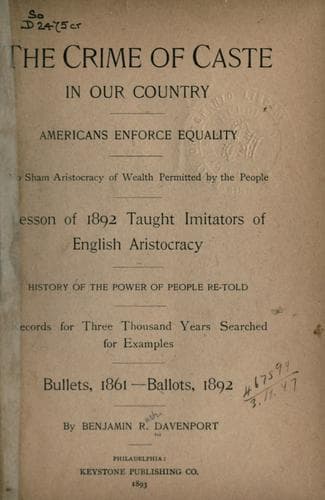
The Crime of Caste in Our CountryDavenport, Benjamin Rush
History
The Crime of Caste in Our Country
Davenport, Benjamin Rush
Social problems; United States -- Social conditions -- 1865-1918
And yet nihilism, socialism, the spirit of revolt, are more powerful
than ever, and ere long will come the upheaval, when all shall be
overturned and “the old shall pass away and all things become new.”
The Russian nobility, with the Czar at their head, as the high priest
of “caste,” are solely and entirely responsible for the spirit of
anarchy and nihilism which is abroad in the domain of immense Russia.
It is a fashion and the fancy of the sham aristocracy in this country
to inveigh against anything like socialism, nihilism, and anarchism in
America. Should the presence of this dread monster, called nihilism,
ever be felt in America, the blame would rest entirely upon the
shoulders of the sham aristocrats, just as the Czar and his nobles in
Russia are responsible for its presence in that country. There must be
a vent for the pent-up indignation of the people; this is, happily for
us, found in the ballot-box. It is to this source of relief that we are
indebted for the non-existence of socialism in America. It has not been
the prudence, wisdom, or consideration of the sham aristocrats which
prevents the growth of nihilism here.
CHAPTER XIX.
PATRICIANS AND PLEBEIANS IN ROME.
There is a striking historical parallelism between the Anglo-Saxons
in modern history and the Romans a thousand years before. The Romans
conquered the world as the Anglo-Saxons are conquering the world. The
Romans were the first race to found and maintain an empire as wide as
the bounds of western civilization. Their characteristic qualities
were, like those of the Anglo-Saxons, their supreme sense of duty,
their respect for law, their great natural aptitude for government,
their earnest practicality, their somewhat deficient sense of the
beautiful, and their high military skill and discipline.
But before Rome could begin her march toward her later position as
mistress of the world she had to rid herself of the domestic incubus of
an internal oligarchy. The authentic history of Rome--for the earlier
annals of her seven kings are little more than legends--opens with the
struggle of the Plebeians--the mass of her people--to break down the
hereditary domination of the privileged “caste,” the Patricians, who
had a monopoly of political power, had appropriated the whole of the
public land, and by unjust laws had burdened the Plebeians with taxes
and debts, and reduced many of them to actual slavery.
In the year 495 B. C., there one day rushed into the crowded forum an
old man, ragged and emaciated, his back covered with bloody stripes. He
loudly proclaimed his history, which was that of hundreds of others. He
had done service in several wars; his farm had been ravaged and burned,
and his cattle driven away; to pay his taxes he had been forced into
debt; his Patrician creditor had demanded a usurious interest, and had
finally compelled him to work as a slave.
Public-domain text, read in full here on John Shaqi.
Reviews
Reviews
No reviews yet
Be the first to share your thoughts on this work.
Elsewhere in the archive
Join the Discussion
Join the discussion
Sign in to leave a comment or review.
Sign InorCreate an account