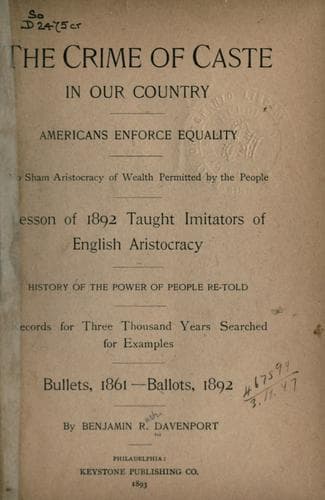
The Crime of Caste in Our CountryDavenport, Benjamin Rush
History
The Crime of Caste in Our Country
Davenport, Benjamin Rush
Social problems; United States -- Social conditions -- 1865-1918
Heedless of the immutable law that only in union is there strength,
Egypt not only became corrupt and tyrannical, but divided into two
kingdoms, who warred furiously against each other. Then it was that the
nomadic hordes of Arabia and Syria saw their opportunity, and, swarming
over the borders (2114 B. C.) and overflowing the valley of the Nile
with a human flood a thousand-fold more destructive than the turbid
inundation of that great river, they crushed the struggling legions
like worms in the dust, and became the masters of the country.
They were the Hyksos, or Shepherd Kings, who stamped their rugged
individuality on that wonderful land. They ruled for four centuries,
forming the fifteenth, sixteenth, and seventeenth dynasties. Their last
king was Apepi, who reigned sixty-one years, and is believed by many
to have been the Pharaoh (“Pharaoh” was the general name for kings) in
whose reign Joseph came into Egypt and was made governor over all the
land.
The Shepherd Kings gradually succumbed to the civilization, culture,
and manners of the Egyptians, and vanished from history by absorption
among those people.
CHAPTER XXII.
CHRISTIANITY.
Aside from the fact of its divine origin and inspired teachers, the
doctrine of Christianity, the advent of the Messiah, was so opportune
that, even had he not been the true Saviour, but taught as he did and
as his disciples did, Christianity, by reason of the condition of the
civilized world, would have made rapid and permanent progress among
the “Common People.” Rome was at that time mistress of the world. Her
empire extended over the whole of Western, and a large portion of
Eastern civilization. Her conquering legions had carried their eagles
to the utmost confines of the then civilized portion of the Western
world.
The cultured Greek and the barbarous Briton, the learned Egyptian and
the warlike Teuton, alike felt the Roman yoke. Palestine was a province
of the great Roman Empire. Roman officials, Roman representatives,
and Roman soldiers ruled the people of Palestine with a rod of iron.
It had once been said that “to be a Roman citizen was to be a king.”
While the Roman Republic had ceased to exist, and the Cæsars ruled in
place of the old republican form of government, creating, as a result
of a monarchy, a nobility, class distinction, and “caste,” still the
traditions and the feelings of the Roman citizen remained with him. He
was a king in comparison with the conquered people of the provinces
which had been added to the Roman Empire.
The Romans were essentially warriors; cruel and oppressive,
merciless and masterful, at every period of the existence of the
Roman government, whether monarchical or republican. But under the
Cæsars there had sprung up a privileged class, the nobility, who
had accumulated vast wealth, surrounded themselves with an army of
retainers and servants, through whom they imposed upon the “Common
People” every kind of oppression imaginable.
Public-domain text, read in full here on John Shaqi.
Reviews
Reviews
No reviews yet
Be the first to share your thoughts on this work.
Elsewhere in the archive
Join the Discussion
Join the discussion
Sign in to leave a comment or review.
Sign InorCreate an account