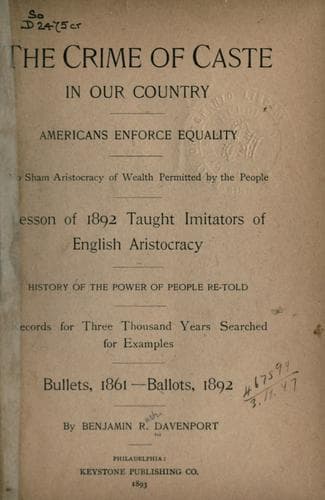
The Crime of Caste in Our CountryDavenport, Benjamin Rush
History
The Crime of Caste in Our Country
Davenport, Benjamin Rush
Social problems; United States -- Social conditions -- 1865-1918
The ending of most oligarchies has been a violent one, as was that of
the Thirty Tyrants at Athens, or that of the Decemviri at Rome. At
Venice the sway of a “caste” lasted for centuries, and was ended only
by a foreign conqueror--so complete an ascendency had the privileged
patricians gained over the fettered populace. The wonderful mercantile
prosperity of the community stifled the sentiment of popular
liberty--a notable warning to mercantile and materialistic America!
No oligarchy, and nothing of oligarchic tendencies can be endured in
this country. We must not and will not have a dominant “caste.”
FOOTNOTES:
[4] In the best age of Athens, life was marked by a dignified and
elegant simplicity. Every free citizen was one of the rulers of the
state, through his vote in the assembly and the law courts; and,
consequently, there was little exclusiveness in social life. An
Athenian might be poor, but if he had general ability, wit, or artistic
skill, he was welcome in the best houses of Athens.--_Sanderson’s
Epitome of History_, p. 169.
[5] Childe Harold, Canto IV.
CHAPTER XXI.
EGYPT, 4235 B. C.
Egypt, the cradle of civilization, had its Democrats, who struck
resistless blows for equality, freedom, and fraternity for the race.
So accustomed have we become, in thinking of Egypt, to be struck so
forcibly by those evidences, the pyramids, of slave labor and the
oppressed condition of the large portion of the ancient population
of Egypt, that the existence of democrats in Egypt seems totally
inconsistent with our preconceived idea of the ancient civilization
of that country. Yet, we find, during the fourth dynasty--4235 B. C.,
the pyramids were builded, and the great Sphinx at Gizeh. The wealth
and splendor of Egypt were unapproached elsewhere; civilization, the
arts and sciences, reached a height which, in some respects, the world
has never known since that time. The civilization of to-day is unequal
to the task of rearing such structures as the pyramids, over which
more than fifty centuries have rolled without displacing a stone or
crumbling a corner of the prodigious masses of granite, hewn from
the distant quarries of Asswan, Mokattam and Tarah, and transported
by means beyond the skill and comprehension of the science of the
nineteenth century.
But with all its splendor, wealth, magnificence and culture, the
kings and rulers of the Fourth Dynasty became corrupt, oppressive and
tyrannical. The Common People, as they were called, revolted, and a
revolution of fire and blood extinguished the dynasty, 3951 B. C.
Public-domain text, read in full here on John Shaqi.
Reviews
Reviews
No reviews yet
Be the first to share your thoughts on this work.
Elsewhere in the archive
Join the Discussion
Join the discussion
Sign in to leave a comment or review.
Sign InorCreate an account