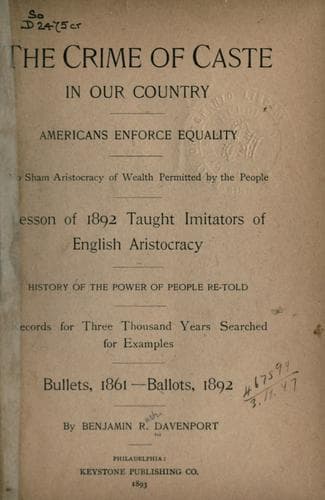
The Crime of Caste in Our CountryDavenport, Benjamin Rush
History
The Crime of Caste in Our Country
Davenport, Benjamin Rush
Social problems; United States -- Social conditions -- 1865-1918
St. Paul, who, of all the early teachers of Christianity, was probably
the “most respectable,” as soon as the angel of God appeared to him,
became converted to the doctrines of Him who was Truth personified,
and threw “caste” to the winds. In the seventeenth chapter of the
Acts, St. Paul, upon Mars Hill, at Athens, proclaimed the equality of
man; in the twenty-sixth verse, he says: “And hath made of one blood
all the nations of men for to dwell on all the face of the earth.”
As God has made us all of one blood, how contrary to the teaching of
Him whom you say you follow, to endeavor to establish a theory that
birth makes a difference and inequality, that there is any peculiarity
about one drop of human blood that makes it better than another. The
teachings of the divine philanthropist, the Saviour of mankind, took
deep and permanent root in the minds of men, because the very essence
of it was that no matter whether the believer in those teachings be
a poor, oppressed Jew, or an outcast Gentile, or a Roman Cæsar, he
stood only before his God as an equal of any other of God’s children.
It was the leveling, the equalizing of rank and power that gave the
impetus, at first, to those truths which are the pillars of the faith
of the Christian nations of earth. “Come, ye who are heavy-laden,” is
the doctrine that appealed to the “Common People.” As lasting and as
abiding as the faith that we have in the Christian religion, so long
and enduring will be the sentiment of the human soul believing in the
equality of man. It has been so from the beginning, and will be to
the end, and surprise and astonishment at each fresh evidence of its
outburst is unnecessary. The plebeians of Rome, before the coming of
the Lord, asserted the same right, and would have sought the Sacred
Hill to establish a city of their own had not the patricians made
concessions. It is the same spirit that cost Charles I. his head, Louis
XVI. his head, the British Government this vast empire, and the same
spirit that, November 8, 1892, cost the Republican party its hold upon
power; because, in the minds of the people, that party was thoroughly
impregnated with the much-hated principle of the inequality of man.
The rich and powerful were the last to be converted to Christianity.
They trembled and said, as the Roman Governor did, “Almost thou
persuadest me to be a Christian,” but not quite, because the very
fundamental principles of the Christian religion are Love, Charity,
and Equality. Their conversion would mean the surrendering of their
cherished claim of “caste.” Many a conversion among the mighty, when at
last effected, was the result of policy upon the part of the converted,
who had commenced to feel the power of the “Common People” who had
listened and become imbued with the divine teachings of the doctrine of
Christianity.
Public-domain text, read in full here on John Shaqi.
Reviews
Reviews
No reviews yet
Be the first to share your thoughts on this work.
Elsewhere in the archive
Join the Discussion
Join the discussion
Sign in to leave a comment or review.
Sign InorCreate an account