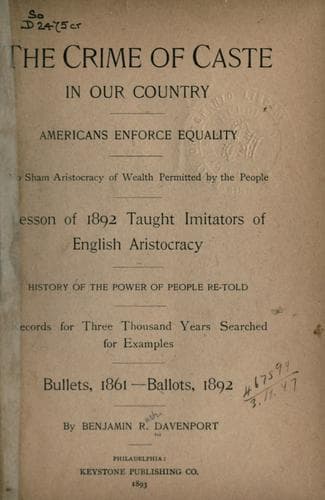
The Crime of Caste in Our CountryDavenport, Benjamin Rush
History
The Crime of Caste in Our Country
Davenport, Benjamin Rush
Social problems; United States -- Social conditions -- 1865-1918
Had it been necessary, as now, to pay salaries of from one to
ten thousand dollars to those teachers who, in the early age of
Christianity, promulgated the doctrines of their God, how few
conversions would have been made at all. These wayfarers, obeying the
divine injunction of our Saviour, to “go and teach all the people of
earth,” took no heed of the morrow. They did not teach in temples which
required thousands of dollars to build; they did not find it necessary
to be surrounded with luxury; they needed no vacations and excursions
to recuperate their exhausted natures. Had it been necessary for
those “fishers of men” to have carriages, temples, and salaries, the
Christian religion would have made exceedingly slow progress. There
were no Astors, Vanderbilts, Rockefellers, in the congregations that
surrounded the early teachers of the doctrine of the meek and lowly
Jesus.
We hear on every side (when this idea is advanced), proclaimed by
the gentlemen of the clerical profession, that “the conditions have
changed.” If such be the case, then history is terribly misguiding. We
are told of the luxuries that surrounded the rich of the Roman empire.
We read, in the Scripture, of Dives, and the rich men of that day. We
know--unless history is entirely in error--that Astors, Vanderbilts,
Rockefellers, existed then. But the early teachers of Christianity
loved their Lord and followed his footsteps, in that he came to give
hope, comfort, and rest to those who were heavy-laden.
The meetings held by the early followers of Christ were not “club
meetings,” at which expensive music entertained the audience.
The audience was not addressed by high-priced elocutionists, nor
entertained by the mental gymnastics of some word-painting acrobat.
Humbly and meekly, hopefully, trustingly, the people sought the
presence of that Teacher whose earnestness and faith was evidenced in
His life and manner of living. His words were blest, all untutored
as he was, with the eloquence of that truth with which his soul was
filled. He did not say to the people, “Give alms,” and at the same
time live in a brown-stone front. He did not say, “Take no heed of the
morrow,” and keep a bank account. He did not preach to his cold and
hungry brother that the Christian religion would give him comfort, and
keep the warm overcoat on his back while doing so.
In their very lives the early teachers of Christianity made the truth
of their own convictions apparent. Is it any wonder that in this, the
nineteenth century, doubt arises in the minds of the people? They doubt
the doctrine because they doubt the sincerity of the teacher. It is so
utterly inconsistent in a man to preach, “If thou wilt be perfect, go
and sell that thou hast, and give to the poor,” while his hearers know
that within a few blocks of where this teacher lives in comfort and
luxury, some poor family is starving.
Public-domain text, read in full here on John Shaqi.
Reviews
Reviews
No reviews yet
Be the first to share your thoughts on this work.
Elsewhere in the archive
Join the Discussion
Join the discussion
Sign in to leave a comment or review.
Sign InorCreate an account