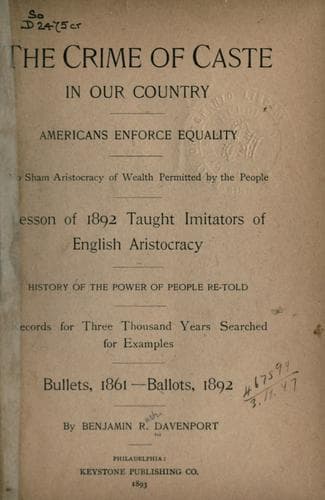
The Crime of Caste in Our CountryDavenport, Benjamin Rush
History
The Crime of Caste in Our Country
Davenport, Benjamin Rush
Social problems; United States -- Social conditions -- 1865-1918
“Various propositions for an income tax come from Democratic
free-traders, who are ready for any scheme for raising revenue
that doesn’t depend upon a protective tariff. Then there are the
Populists, Nationalists, and divers miscellaneous cranks who
object to wealth on general principles. Other men’s wealth, of
course. To these powerful thinkers an income tax is a penalty
to be inflicted upon the plutocrats, a discouragement to the
acquisition of money. There is much flabby talk about plutocracy,
and a good deal of the talk in favor of an income tax is of that
nature.
“With the opinions of the Populists we are not concerned, except
as students and observers of the political curiosities of the
time. It is proper, on the other hand, to remind Democrats that an
income tax is undemocratic. Undemocratic in principles, because
it is an interference with individual business and a premium upon
perjury. Undemocratic in precedent, because the imposition of such
a tax was unanimously and strenuously opposed by the Democratic
party, and because the extension of the life of that tax from 1870
to 1872 was likewise opposed, with substantial unanimity, by the
Democratic party.
“The only excuse for the income tax was that it was a war measure.
What excuse can be given for reimposing it? Is there a war against
money or against common-sense?”
Democratic free-traders, so obnoxious to the New York _Sun_, by the
suggestion of an income tax, are merely seeking for means whereby the
expenses of the Government may be defrayed. They know that something
is the matter with the Democratic masses, who have shown their
dissatisfaction with the existing state of things. These Democratic
free-traders (and they fairly represent the doctrine proclaimed as a
principle of the Democratic party, and adopted as a platform in the
Chicago Convention) know that if they are to be consistent they must
abolish, to a great extent, the duties upon imported articles. They
also know that if they abolish duties, there will not be sufficient
money paid into the treasury of the United States to defray the current
expenses of the Government. They have realized the powerful current of
public opinion, which demands the equalization of taxes between those
who enjoy the benefits of living under the government of the Federal
Union. The tariff duties do not fall with the same proportionate weight
upon the rich and the poor. The rich derive greater benefit from the
security offered their property than the poor, as the amount of their
property is greater than that of the poor; yet a Vanderbilt consumes
no more sugar, and therefore pays no more duty, than the Homestead
striker.
The Democratic free-trader, “with his flabby talk of an income tax,” is
merely seeking for a means to furnish, upon something like an equitable
basis, the money necessary to run the Government.
Public-domain text, read in full here on John Shaqi.
Reviews
Reviews
No reviews yet
Be the first to share your thoughts on this work.
Elsewhere in the archive
Join the Discussion
Join the discussion
Sign in to leave a comment or review.
Sign InorCreate an account