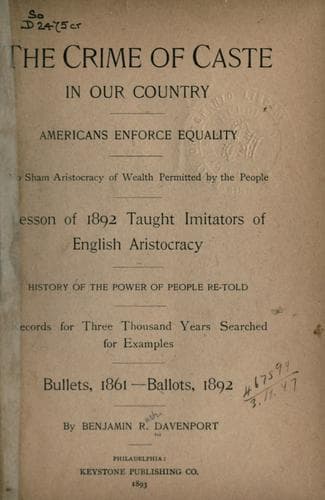
The Crime of Caste in Our CountryDavenport, Benjamin Rush
History
The Crime of Caste in Our Country
Davenport, Benjamin Rush
Social problems; United States -- Social conditions -- 1865-1918
The “Populist, Nationalist, and divers miscellaneous cranks” (referred
to in the editorial quoted) call to mind the Abolitionists of 1856, who
were spoken of with so much contempt, and yet who, four years after, as
the Republican party, with Abraham Lincoln as their candidate, swept
the country. If “flabby talk” means a demand made by the people upon
the wealthier class to render unto the Government in proportion to
benefits conferred by the Government, then let “flabbyism” continue to
characterize the talk of our legislators, because it would be, with all
of its “flabbiness,” a welcome doctrine to the “Common People.”
The editorial under discussion goes on to recite the fact that the
opinions of “the Populist are not worthy of concern, except to those
students and observers of the political curiosities of the times.”
Again is called to mind the studies and observations made concerning
“curiosities” that existed in the political firmament in 1856, and
resulted in the AURORA BOREALIS in 1860.
This editorial, which is worthy of great attention, emanating from the
source that it does, reminds the Democrats (meaning the Democratic
party) that an income tax is “undemocratic--undemocratic in principle,”
because the Democratic party strenuously opposed the life of that tax
from 1870 to 1872. There is _not_ a shadow of doubt that an income tax
is _not_ in accordance with the principles of that party which bears
the name of the _Democratic party_; but that _it is in accordance_
with _democracy_ and the _feelings_ that fill the breasts of the
masses who voted last November for Grover Cleveland, and no one better
understands the fact that the victory of last November was not won by
the Democratic party, as a party, than the one man most benefited and
elevated thereby; that is, the President-elect, Grover Cleveland.
The howl that one thing or another is “not according to the principles
of the Democratic party,” ought to have but little effect upon him;
and, judging from the editorial of November 21st, which appeared in
that other journalistic pillar of the Democratic party, the New York
_World_, Grover Cleveland appreciates the exact position of affairs,
and how and why he was elected.
THE FRUITS OF VICTORY.
“Mr. Cleveland’s speeches since the election are even better than
those which he made in the campaign. There is an advantage in
perfect freedom.
“No truer or more philosophical statement of the causes that
underlay the recent political revolution has been made than
was contained in Mr. Cleveland’s brief speech at the Manhattan
Club. ‘The American people,’ he said, ‘have become politically
more thoughtful and more watchful than they were ten years
ago. They are considering now vastly more than they were then
political principles and party policies, in distinction from party
manipulation and the distribution of rewards for partisan services
and activities.’
Public-domain text, read in full here on John Shaqi.
Reviews
Reviews
No reviews yet
Be the first to share your thoughts on this work.
Elsewhere in the archive
Join the Discussion
Join the discussion
Sign in to leave a comment or review.
Sign InorCreate an account