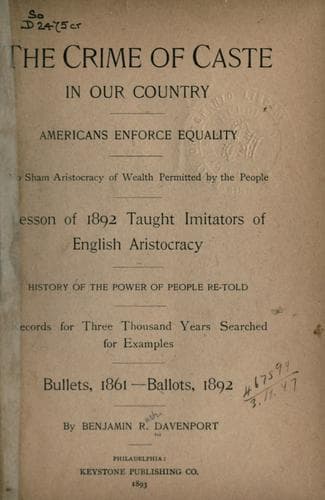
The Crime of Caste in Our CountryDavenport, Benjamin Rush
History
The Crime of Caste in Our Country
Davenport, Benjamin Rush
Social problems; United States -- Social conditions -- 1865-1918
It is impossible to ascribe this change to increased emigration and the
fact that recently naturalized citizens voted the Democratic ticket. In
the first place, there is no such unanimity of love for the Democratic
party, as a _party_, in the breasts of the emigrants who have been
recently naturalized, as to account for their voting unanimously the
Democratic ticket. Again, the number of foreigners who have been made,
by naturalization, citizens of the United States within the last four
years is not sufficient to account for this tremendous revolution;
and, further, the greatest gains made by the Democratic nominee were
not made in those sections wherein the greatest flood of emigration
has poured. Therefore, it seems conclusive that the nominee of the
Democratic party received the support of Americans who had formerly
voted with the Republican party.
Now, upon what ground can this general conversion rest? It was not done
by the flaring of trumpets, by oratory, or reasoning upon the issues as
set forth in the platforms of the two parties. It is hard to imagine
many voters being convinced of the advantages that would arise under a
system of State banks. It would seem that that would convince few, if
any, that the Democratic party was more desirable than the Republican
party, to have in charge of the finances of the nation. That, as an
abstract principle, “Free Trade,” or “tariff for revenue only,”
converted this large number of former Republican voters, is a statement
not justified by the vote cast in different States, nor is it possible
to find one man, in each hundred who voted the Democratic ticket, who
can intelligently discuss the subject of Protection and Free Trade and
give satisfactory reasons for preferring Free Trade. The subject is a
perplexing one, even to those who have devoted much time and study to
political economy.
To show a lack of unanimity among the high priests of Democracy on
the subject of Protection and Free Trade, one has only to refer to
the record of the late and eminent Samuel J. Randall, who was a most
pronounced Protectionist, yet a sterling member of the party known
as the Democratic party. On the other hand, we have the Hon. John G.
Carlisle, Senator from the State of Kentucky, who represents ultra
Free Tradeism. Even the same difference exists between those two great
journals, in which are supposed to be mirrored Democratic doctrines
and principles: the New York _Sun_, whose editorial is here quoted,
which is an absolute Protection organ, and the New York _World_, whose
editorial is also quoted, the last-named paper being an absolute Free
Trade organ.
It would seem perfectly apparent to even the most benighted mind
that, with such divergence of opinion among the old-line Democrats,
a doctrine not believed in unanimously by them, could make but few
converts from the ranks of the party pledged to Protection.
Public-domain text, read in full here on John Shaqi.
Reviews
Reviews
No reviews yet
Be the first to share your thoughts on this work.
Elsewhere in the archive
Join the Discussion
Join the discussion
Sign in to leave a comment or review.
Sign InorCreate an account