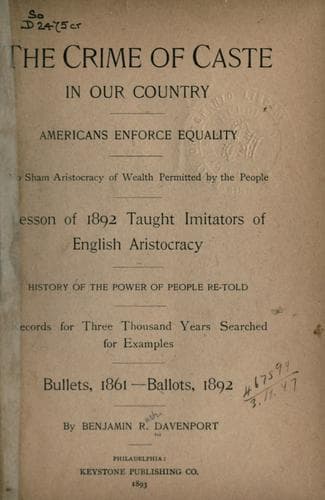
The Crime of Caste in Our CountryDavenport, Benjamin Rush
History
The Crime of Caste in Our Country
Davenport, Benjamin Rush
Social problems; United States -- Social conditions -- 1865-1918
Free Trade and State banks were the two leading cries in the campaign
of the Democrats, joined to which was occasionally heard the cry of
fear of a Force Bill.
The worthy New York _Sun_ would, doubtless, attribute largely the
victory to its efforts in calling the attention of the public to the
Force Bill and the danger of its passage if the Republicans should gain
the control of the Federal Government. As a matter of fact, however,
the people of the Union had seen the Republicans in power, controlling
both branches of the National legislature, and also the executive
department of the Government; yet, the people have seen the Lodge Bill,
known as the Force Bill, pass the Republican House of Representatives,
and die a doleful death in the Republican Senate, killed by the votes
of Republican Senators. Therefore, that part of the Democratic policy
which indicated a strenuous objection to the passage of a Force Bill,
if put in power, could not possibly have a great deal of effect in the
missionary work done by the Democratic managers. Those Republicans who
voted for the nominee of the Democratic party, at the last election,
could not have been influenced to do so by the arguments advanced with
regard to the Force Bill.
They had seen Senators of their own, the Republican party, kill a
Force Bill in the Senate of the United States, and they had no reason
to believe but that a recurrence of murder would take place should
another Force Bill pass the House of Representatives and be sent to a
Republican Senate. These three leading features of the Democratic party
appear most prominently in the campaign. Can any fair man say that any
one or all of them influenced those Republicans who voted for Grover
Cleveland to change from the Republican party and become members of the
Democratic party? Is there anything in any one of them or all of them
jointly to make a man forsake old associates, old ideas and faiths, and
to associate himself, by reason of conviction, with things that are new?
It could not be a matter of reason. It was a matter of sentiment. And
(again repeating) no one seems to understand that to be the case better
than the President-elect. It was the sentiment of detestation upon the
part of the masses--the “Common People”--for that assumption of class
distinction, the attempted introduction of “caste” in our country
by those who are allied to, or who had forced themselves upon, the
Republican party.
Public-domain text, read in full here on John Shaqi.
Reviews
Reviews
No reviews yet
Be the first to share your thoughts on this work.
Elsewhere in the archive
Join the Discussion
Join the discussion
Sign in to leave a comment or review.
Sign InorCreate an account