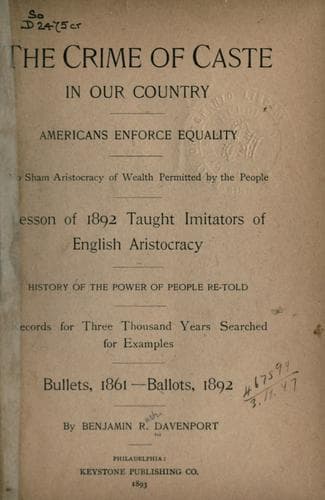
The Crime of Caste in Our CountryDavenport, Benjamin Rush
History
The Crime of Caste in Our Country
Davenport, Benjamin Rush
Social problems; United States -- Social conditions -- 1865-1918
The symmetry, beauty, and virtues so pre-eminent in the party of
Abraham Lincoln in 1860, will ever present a spectacle for the
admiration of the “plain” “Common People” of America. They loved the
Republican party in 1860, and cast their votes for it because it
represented them--the plain “Common People”; because the candidate of
the Republican party, Abraham Lincoln, was one of them, the “Common
People”; because in the right hand of the Republican party was carried
the standard of _equality and emancipation_; because in their
standard-bearer, Abraham Lincoln, the plain people recognized a typical
man of the “Common People.” “Mudsillism” was synonymous to them with
the term “Common People.” The industrial and laborial North was aroused
to righteous indignation by the assumption of a social superiority on
the part of the cavaliers, the believers in “caste,” in the South.
The Republican party, led by that wonderful creation of the American
soil and the air of freedom, Abraham Lincoln, won the battle of the
equality of man in 1861-65. Following still the guiding star which had
left its reflected glory upon the horizon even after it had descended
into the tomb made by the assassin, the people of the Union elected the
victorious general, Ulysses S. Grant, to the office of Chief Executive
of the nation. Believing in and trusting the man who had been a friend
to Abraham Lincoln, when he was surrounded by a multitude of dangers,
they cheerfully re-elected the victorious General Grant to be the
President of the people for a second term.
Slowly, but none the less surely, had been going on, during General
Grant’s administration, the disintegration of those principles that
made the party of Abraham Lincoln _great_ in the eyes of the “Common
People” of the Union. After twice enjoying the exalted position of
Chief Magistrate of the nation, General Grant was called upon to
surrender his office to a successor. So great had been the inroads
of decay upon that sterling honesty of the Republican party--that
Republican party which had been planted by the loving hands of Lincoln
in the breasts of the American people--that President Hayes succeeded
General Grant, as a Republican President, only by concessions made in
the interests of peace by a great statesman, Samuel J. Tilden.
Public-domain text, read in full here on John Shaqi.
Reviews
Reviews
No reviews yet
Be the first to share your thoughts on this work.
Elsewhere in the archive
Join the Discussion
Join the discussion
Sign in to leave a comment or review.
Sign InorCreate an account