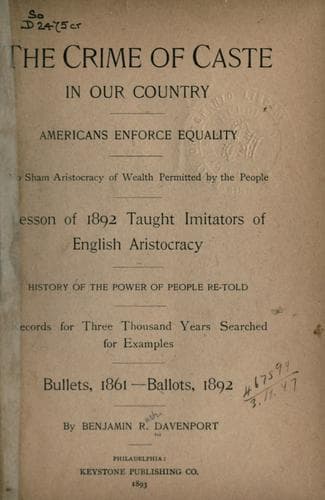
The Crime of Caste in Our CountryDavenport, Benjamin Rush
History
The Crime of Caste in Our Country
Davenport, Benjamin Rush
Social problems; United States -- Social conditions -- 1865-1918
The weakening influence of the barnacles growing upon that stalwart
tree of Republicanism, and which had been washed there by the ocean
tide of prosperity that had surged upon our nation, was felt in
the campaign between Hayes and Tilden. And let all good Americans,
Republicans as well as Democrats, uncover their heads in speaking of a
man like Tilden, who was a man of the people, thought of the people,
and of the horrors of civil war. Each succeeding administration tended
but to weaken the hold of that good old Republican party, that Grand
Old Party! (and it gives us pleasure to say it) upon the hearts of
the American people, because the barnacles which had clung on to the
life-giving roots of the stalwart oak of Republicanism and the Grand
Old Party--those barnacles of sham aristocracy, believers in “caste”
and class distinction, the wealthy--had managed to sap the strength of
the vigorous young tree planted by Abraham Lincoln, until, deformed,
it presented a spectacle obnoxious to the eyes of the “Common People”
of America.
The first decisive evidence of the dissatisfaction of the people was
given in the election of Grover Cleveland in 1884.
While Burchard, with that remarkable alliteration, “Rum, Romanism, and
Rebellion,” is accredited with having caused the defeat of James G.
Blaine, the impression made upon the “Common People” by the spectacle
of that dinner of millionaires, called the “Belshazzar feast,” at which
the nominee of the Republican party, James G. Blaine, occupied a seat,
was much greater than the howling of “Rum, Romanism, and Rebellion,” by
an obscure preacher.
The Republican party had ceased to represent to the minds of the plain
“Common People” what it had originally represented. There had grown
upon that party the fruit of evil, in the shape of a moneyed class, who
assumed to be better than the plain “Common People” of America. Hence,
James G. Blaine, with all his personal popularity, magnetism, and
magnificent record, was unable to secure, from the ranks of the “Common
People,” the votes necessary to elect him President.
The defeat of Grover Cleveland by President Harrison was brought about
(and there can be no doubt of it) largely by the use of money, secured
as contributions from the moneyed class to perpetuate the control of
the Republican party in the Federal Government, thinking that by so
doing the power and assumption of social superiority upon the part of
believers in “caste,” who cared nothing about the principles of the
original Abraham Lincoln Republican party, and who were as far beneath
it in patriotism, honesty, and truth as the earth is beneath the
heavens, would also be perpetuated.
Public-domain text, read in full here on John Shaqi.
Reviews
Reviews
No reviews yet
Be the first to share your thoughts on this work.
Elsewhere in the archive
Join the Discussion
Join the discussion
Sign in to leave a comment or review.
Sign InorCreate an account