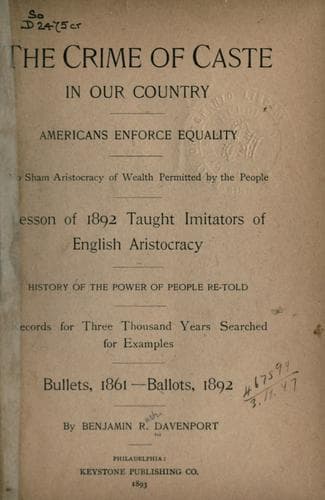
The Crime of Caste in Our CountryDavenport, Benjamin Rush
History
The Crime of Caste in Our Country
Davenport, Benjamin Rush
Social problems; United States -- Social conditions -- 1865-1918
But the people said, November 8, 1892, it matters not whether the
currency be debased or not. We, the plain “Common People,” will not
be debased into social inferiority! It matters not whether there be
thousands of counterfeits in the currency of the community. We would
rather have counterfeited currency than counterfeited aristocracy! The
dollar to-day, guaranteed by the faith of the Federal Government,
may be worth a hundred cents, and we’ll make it worth only fifty
cents, as guaranteed by each State in the Union, but the position,
socially and otherwise, of each man and citizen of the Union must be
worth a _hundred cents_. And we are weary at the attempt made by sham
aristocrats to depreciate the value of that doctrine, which is dearer
to the American than dollars and cents--the EQUALITY OF MAN.
With regard to the Force Bill, the Republican party had the best of
the argument. Their platform, as adopted in Minneapolis, only indorsed
the idea of a fair, free, and honest election, all of which was
but the reiteration of part of that Rock of Ages for the patriotic
American--the Constitution of the United States. Can any man argue
that, as a good citizen of the Union, it is proper for him to believe
in anything other than a fair, honest election? If there be such, he
is not to be found in the ranks of the plain, common, honest people,
who absolutely abhor any fraud upon their franchise as citizens of the
United States.
So that, in point of fact, apparently the three great issues to be
decided in the last campaign by the American people were: Protection
_versus_ Tariff; National Banks _versus_ State Banks; Fair Elections
_versus_ Frauds on the Franchise.
Without a moment’s hesitation, the American people would have decided
that the Republican party should continue in control of the affairs
of the nation, especially when that Republican party had for its
standard-bearer a man who, like Benjamin Harrison, possessed the
confidence of the American people--a man in whom the American people
recognized every patriotic principle inherent in the breasts of the
common, plain people of America.
But the Republican party of 1892 had become lost in the mist arising
from the exhalations from the manure heap of sham aristocracy and
“caste.” Figures looming out of the gloom of the present, hardly
compare favorably with those giants who cultivated the soil in which
was planted the Republican oak tree.
Through the miasma arising from the rotting present of the Republican
party, the picture of Thomas Platt appears. In the pellucid atmosphere
of the Republican party of the past, we see the picture of Seward.
Amidst the odoriferous present we find the likeness of the skillful,
the Honorable Matthew S. Quay. Upon the clear sky of the past is
mirrored the majestic Roscoe Conkling.
Public-domain text, read in full here on John Shaqi.
Reviews
Reviews
No reviews yet
Be the first to share your thoughts on this work.
Elsewhere in the archive
Join the Discussion
Join the discussion
Sign in to leave a comment or review.
Sign InorCreate an account