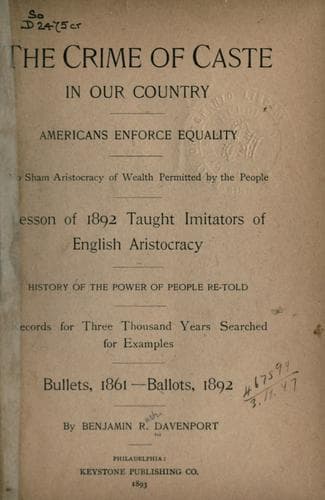
The Crime of Caste in Our CountryDavenport, Benjamin Rush
History
The Crime of Caste in Our Country
Davenport, Benjamin Rush
Social problems; United States -- Social conditions -- 1865-1918
Amidst the hurly-burly and charlatan parade of the present, we
perceive that prince of clowns and jesters, Chauncey M. Depew, king
of after-dinner speech-makers, the witty buffoon who represents the
princely Vanderbilts, the man who was never heard of except when
clothed, either in dress suit or imported English clothing. By the side
of this figure of the present, look back and see the picture of that
man of the Republican party who met Stephen A. Douglas on the stump in
Illinois, whose jests were filled with the meat of common-sense, whose
heart was an out-gushing spring of kindness towards his fellow-men,
the “Common People.” Place the present picture, Chauncey M. Depew, in
dress suit, supported by the Vanderbilts’ millions, beside the long,
angular figure of that Illinoisian, Abraham Lincoln, supported by the
people--but pause; this is sacrilege!
Republicans, you know why your party was defeated. Be frank; be brave;
be manly, and charge it upon the proper cause--“caste!” affectation!
sham aristocracy! degeneracy!
CHAPTER XXV.
THE POPULIST: THE “ALLIES.”--ELECTED BY THE PEOPLE; THEREFORE, WITH THE
“COMMON PEOPLE.”
It does not seem to afford any great amount of pleasure for the
hide-bound members of the Democratic party, the thought that possibly
the Democratic party may become but a fifth wheel to the coach, and
they view with evident dislike the growing power of the Populist party.
Quoting from the New York _Sun_, of December 11th, that able
representative, in a journalistic way, of the Protection Democrats, we
print the following statements:--
WEAVER AND HIS MILLION VOTES.
“The Populists are naturally excited and encouraged by their
demonstration of numerical strength at the election of 1892. The
Populist view of the achievement, and the Populist interpretation
of its significance, are set forth in detail in the very
interesting summary of results printed in another part of this
paper. In brief, the claim is this:--
“One million votes in the South and West for the Weaver electors;
“Twenty-three electoral votes obtained by fusion or otherwise;
“Five Populist Senators and ten Populist Representatives in the
next Congress;
“Populist State Governments in Kansas, Colorado, and North Dakota,
and greatly increased Populist representation in the legislatures
of these and several other States;”
Which evidently furnishes no great amount of satisfaction to that
organ, which is essentially Democratic in a party sense.
Public-domain text, read in full here on John Shaqi.
Reviews
Reviews
No reviews yet
Be the first to share your thoughts on this work.
Elsewhere in the archive
Join the Discussion
Join the discussion
Sign in to leave a comment or review.
Sign InorCreate an account