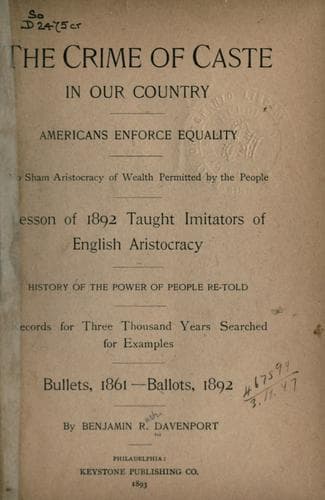
The Crime of Caste in Our CountryDavenport, Benjamin Rush
History
The Crime of Caste in Our Country
Davenport, Benjamin Rush
Social problems; United States -- Social conditions -- 1865-1918
“This last item is the deduction of optimism from the foregoing.
The heavy popular vote for the Populist electors in some of
the Southern States serves principally to show that under the
conditions existing in 1892, the solid South would have been
broken and its solid electoral vote lost to the democracy had
not the Force Bill issue been put at the front. The twenty-three
electoral votes credited to Weaver in the West and Northwest
separate themselves, on analysis, into elements in which the
Omaha platform and the specially characteristic features of the
Alliance movement sustain a subordinate part. Colorado and Nevada
went for Weaver because they were for silver, not because they
were for Weaver. Kansas, Idaho, North Dakota, and the one vote in
Oregon were gained by the acquiescence of the Democratic managers
in a scheme of fusion obviously to the advantage of the Democratic
national ticket. Weaver’s proportion of the vote, either popular
or electoral, cannot be accepted as a trustworthy measure of the
growth of public sentiment in the West in favor of the general
programme drawn up at Omaha.
“The first solid and effective achievement in the list is the
direct gain of the Populists in their representation in the
Congress of the United States. This means something. They must
have Senators and Representatives if they are ever going to shape
the legislation of the country; and until they can legislate, or
muster sufficient strength at the Capitol to force legislation
agreeable to their ideas of public policy, they have accomplished
nothing. Now they turn up with five Senators, as they believe,
and with at least ten Representatives, as they have reason to be
certain. It is a respectable showing for a new party, even if we
do not count the silver Senators as Populists out and out. But,
as an indication of the probable strength of the Populists in the
Fifty-fourth Congress, or in the Fifty-fifth, as a reasonable
assurance of future progressive development, it is worthless.
We need only remind the Populists that their predecessor, the
so-called National party, representing the greenback craze, and,
in a measure, the dissatisfaction with political conditions that
marked the period after the counting in of Hayes, went into the
Forty-sixth House with fourteen Congressmen. The Greenbackers
and Readjusters went into the Forty-seventh House with eleven
Congressmen. In the Forty-eighth, their strength dropped to two.
The Greenback wave had swept off and away; the two old parties
confronted each other as before, and the phenomenon of a third
party in Congress, mustering more than a dozen lawgivers, had
disappeared as utterly as if it had never been.
Public-domain text, read in full here on John Shaqi.
Reviews
Reviews
No reviews yet
Be the first to share your thoughts on this work.
Elsewhere in the archive
Join the Discussion
Join the discussion
Sign in to leave a comment or review.
Sign InorCreate an account