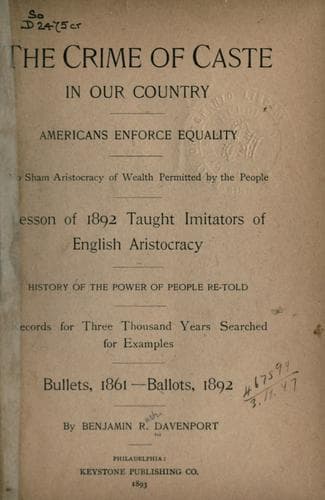
The Crime of Caste in Our CountryDavenport, Benjamin Rush
History
The Crime of Caste in Our Country
Davenport, Benjamin Rush
Social problems; United States -- Social conditions -- 1865-1918
“To find out why the people voted as they did, one must ask
them. It is they that have piled up these great majorities, and,
seemingly, have repudiated Republican doctrines, and put the seal
of disapproval upon what the Republican party believes has given
this country unexampled prosperity. Let any man who believes
that the ‘popularity’ of Grover Cleveland, the demand for free
trade, or any policy which is shown in the Democratic platform,
other than that which embodies the general statement that the
Democrats will give the country better times, is the cause of
Republican defeat, ask the people why they voted as they did, and
he will find that it is this tendency, unconscious and entirely
undeveloped, toward socialism which has given the Democrats
victory. It is not permanent nor lasting, so far as it exists in
seeming antagonism to Republican policies. In 1896 a cyclone of
disapproving votes is just as likely to sweep over the Democratic
camp as it has this year devastated the Republican stronghold.
“But it is one thing to make a statement, and another to prove
it. In order to ascertain what it was that brought defeat to the
Republican party, I took a trip through the States of New York and
Vermont, and in five days interviewed several hundred laboring
people and men who are in business in a small way in various
mercantile pursuits, and who voice the opinion and sentiments of
thousands in similar walks of life. Talk with many was profitless.
They had nothing against President Harrison, nothing in particular
that they knew of against Protection. They did not vote the
Democratic ticket because they were impressed with the greatness
of Mr. Cleveland, or with the soundness of his views, or with the
policy of the party as presented in the Chicago platform. They
said they wanted better times and more money. They wanted cheaper
clothing, cheaper fuel, cheaper everything; but they wanted to
sell what they had to sell, whether it be labor or goods, at the
highest possible price. They did not, because they could not, deny
that the country as a whole had grown vastly prosperous under
Republican administrations.
“They were not sure that the McKinley bill or previous tariffs had
had anything to do with the hard times which they declared exist.
The laborer could not say but what the cost of store articles had
decreased largely in the last quarter of a century. In fact, many
of them could remember when articles of common consumption and
use cost much more than they do to-day; while the products of the
farmer and the stocks of the shopkeeper, so the farmer and the
tradesman were obliged to affirm, were sold not many years ago at
a lower price and with less profit than to-day.
Public-domain text, read in full here on John Shaqi.
Reviews
Reviews
No reviews yet
Be the first to share your thoughts on this work.
Join the Discussion
Join the discussion
Sign in to leave a comment or review.
Sign InorCreate an account