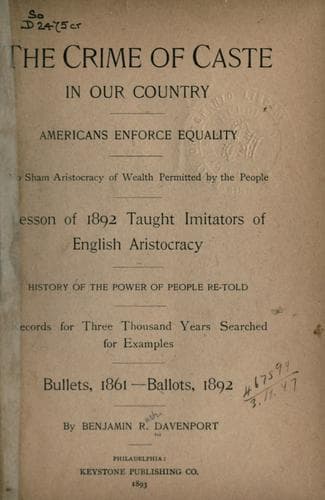
The Crime of Caste in Our CountryDavenport, Benjamin Rush
History
The Crime of Caste in Our Country
Davenport, Benjamin Rush
Social problems; United States -- Social conditions -- 1865-1918
“As a child,” writes this scion of a race of nobles(?), “I had often
listened with great interest to my father’s account of his visit to
London, with Dominick Lynch, the greatest swell and beau that New
York had ever known. He would describe his going with this friend to
Almack’s, finding themselves in a brilliant assemblage of people,
knowing no one and no one deigning to notice them; Lynch, turning to my
father, exclaimed: ‘Well, my friend, geese, indeed, were we, to thrust
ourselves in here, where we are evidently not wanted.’ He had hardly
finished the sentence when the Duke of Wellington (to whom they had
brought letters, and who had sent them tickets to Almack’s) entered,
looked around, and seeing them, at once approached them, took each
by the arm and walked them twice up and down the room; then, pleading
an engagement, said ‘Good-night’ and left. Their countenances fell as
he rapidly left the room, but the door had barely closed on him when
all crowded around them, and in a few minutes they were presented to
everyone of note, and had a charming evening. He described to us how
Almack’s originated--all by the banding together of powerful women of
influence for the purpose of getting up these balls, and in this way
making them the greatest social events of London society.
“Remembering all this, I resolved, in 1872, to establish in New York an
American Almack’s, taking men instead of women, being careful to select
only the leading representative men of the city, who had the right to
create and lead society. I knew all would depend upon our making a
proper selection. I made up an Executive Committee of three gentlemen,
who daily met at my house, and we went to work in earnest to make a
list of those we should ask to join in the undertaking. One of this
committee, a very bright, clever man, hit upon the name of ‘Patriarchs’
for the Association, which was at once adopted, and then, after some
discussion, we limited the number of Patriarchs to twenty-five, and
that each Patriarch, for his subscription, should have the right of
inviting to each ball four ladies and five gentlemen, including himself
and family; that all distinguished strangers, up to fifty, should be
asked; and then established the rules governing the giving of these
balls--all of which, with some slight modifications, have been carried
out to the letter to this day. The following gentlemen were then asked
to become ‘Patriarchs,’ and at once joined the little band:
Public-domain text, read in full here on John Shaqi.
Reviews
Reviews
No reviews yet
Be the first to share your thoughts on this work.
Elsewhere in the archive
Join the Discussion
Join the discussion
Sign in to leave a comment or review.
Sign InorCreate an account