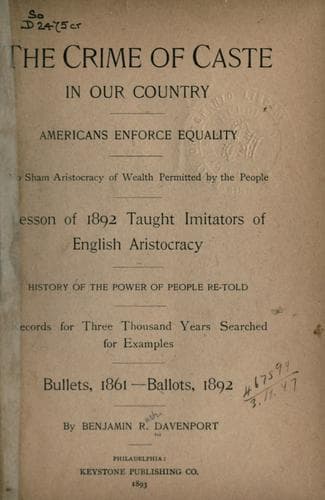
The Crime of Caste in Our CountryDavenport, Benjamin Rush
History
The Crime of Caste in Our Country
Davenport, Benjamin Rush
Social problems; United States -- Social conditions -- 1865-1918
An explanation of the cause for the dearth of good domestic servants
was sought by a great New York daily newspaper. It opened its columns
and asked for communications explaining why a young woman preferred to
work in a shop ten or twelve hours a day, and receive therefor three
dollars a week, rather than accept a position as a domestic servant, in
your house, Madame, where she would have greater comfort in the way of
food and lodging, and receive more dollars.
Read the answers received by the _Recorder_, of New York. In almost
every instance, the writer of the communication would say that it
was not a matter of food, lodging, and dollars, but a matter of
self-respect. They were snubbed and sat upon when engaged in serving
the rich.
Go to any fashionable restaurant, or saloon, where the would-be swells
swill champagne. Ask the attendants their opinion of those who, with a
supercilious air, throw them a dollar to fee them for their services.
You will hear expressed, in reply to your question, opinions like this:
“I feel like knocking their heads off. I am ready to work. I don’t
want their money for nothing; but I am a _man_, and as good as they
are.”
The workman was content, nor did it interest him if the rich should
drive their Tally-hos. He had no desire to divide the money of the
purse-proud devotee of “caste”; but when, weary from his day of labor,
trudging along the road to his humble home, with tooting horn and
flourish of whip the Tally-ho sweeps by him, and he has to scurry out
of the road, he long remembers the derisive smile of the insolent,
purse-proud occupants of the coach, and he objects--not to the
coach--but to the manner and the smile of the occupants.
The heart of the shop-girl or the seamstress is not filled with envy
because the fine lady (?) of fashion possesses garments of silk and
laces; but the insolence and supercilious manner, when the fine lady
(?) brought in contact with her, fills her soul with a sense of injured
dignity. She knows she’s quite as good as a lady of fashion. Possibly
her father is not a protected, petty manufacturer; and she goes to
her home, resenting the assumed superiority in the manner of the fine
lady, and preaches to father, brother, and lover equality and broad
democracy. The fine ladies (?) of fashion have ever been most potential
causes for victories by the people. No orator so eloquent as the wife,
daughter, sister, or sweetheart; and her wrongs were resented November
8th.
[Illustration: “THE PUBLIC BE D----D!”]
The New York _World_, of November 20th, 1892, publishes an article in
connection with New York society, that, having received a place in that
great Democratic journal, because of its undoubted truth, is worthy of
a place in this volume. In speaking of the death of Mrs. Belmont, the
_World_ makes use of the occasion to express some remarkably forcible
facts with regard to New York society. It says:--
Public-domain text, read in full here on John Shaqi.
Reviews
Reviews
No reviews yet
Be the first to share your thoughts on this work.
Elsewhere in the archive
Join the Discussion
Join the discussion
Sign in to leave a comment or review.
Sign InorCreate an account