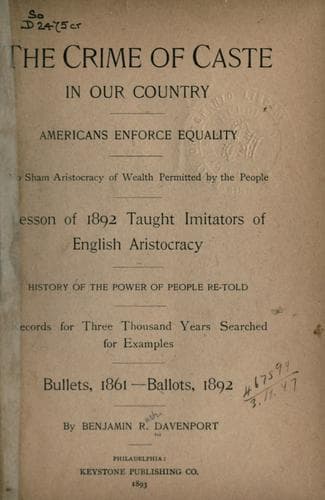
The Crime of Caste in Our CountryDavenport, Benjamin Rush
History
The Crime of Caste in Our Country
Davenport, Benjamin Rush
Social problems; United States -- Social conditions -- 1865-1918
“In the social history of New York it will be a lasting
distinction to Mrs. Belmont that she was a conspicuous figure in
good society before good society had been vulgarized. I have no
quarrel with the society of to-day, which has merely followed the
law of its evolution. I merely insist that the New York society
of thirty years ago had all the good features of to-day, and was
conspicuously free from certain faults which are now conspicuously
prominent. The society which accepted the leadership of Mrs.
Belmont had birth, and breeding, and culture, ample means and
true refinement, and it had also that last test of a genuine
aristocracy, that it held its rank by unquestioned title. It had
so little fear of the security of its position that it freely
admitted strangers of equal social rank.
“_It was possible for a rich merchant to permit a clerk to visit
at his house_, and even scholars and educated people were not
considered detrimental. While it had the respect of ingenuous
youth for the older aristocracies of Europe, it did not abase
itself in comparison with them, and was incapable of servility
before them or before anything human. _It was singularly free from
scandals._”
Then, thirty years ago,--that is, at the time of Abraham Lincoln’s
great popularity, succeeding by two years the great uprising of the
Common People, the “mudsills,” of the North and West,--a wealthy
merchant of the North would receive his clerk, as a social equal, in
his house. Then times have changed, and manners with them, within
the last thirty years! The rich merchant of to-day has forgotten
the force of the argument which resulted in the election of Abraham
Lincoln,--“Americans enforce Equality.” Two years was not enough,
thirty years ago, to enable the rich merchant to forget that the first
man of the nation, the President of the Union, had been a laborer,
rail-splitter, clerk in a grocery store, and was, while chief of the
nation, still a man of the “Common People.” No, two years was not
enough to bring about forgetfulness of these facts; but _thirty-two_
years was.
Hence, the overturning of the aristocratic party (or that party to
which the aristocrats belong) cost what it might in dollars to the
“Common People.” It is not a new economic doctrine that they demand; it
is a new social system. While the assumed aristocracy of thirty years
ago may have had respect for the older aristocracies of Europe, it most
certainly did not abase itself, and was not as servile to them, as is
the sham aristocracy of to-day.
Quoting from the Koran of that high priest of the “smart set,”
McAllister, who utters the sentiments of the most exalted in the holy
of holies in swelldom:--
Public-domain text, read in full here on John Shaqi.
Reviews
Reviews
No reviews yet
Be the first to share your thoughts on this work.
Elsewhere in the archive
Join the Discussion
Join the discussion
Sign in to leave a comment or review.
Sign InorCreate an account