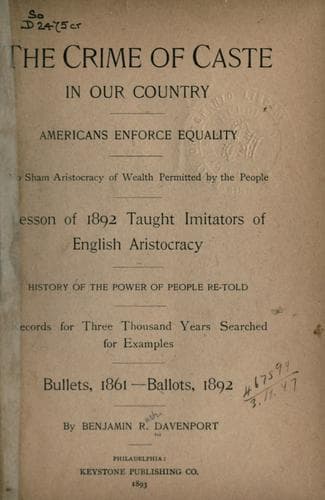
The Crime of Caste in Our CountryDavenport, Benjamin Rush
History
The Crime of Caste in Our Country
Davenport, Benjamin Rush
Social problems; United States -- Social conditions -- 1865-1918
“It is well to be in with the nobs who are born to their position,
but the support of the swells is more advantageous--for society is
sustained and carried on by the swells, the nobs looking quietly
on and accepting the position, feeling that they are there by
divine right; but they do not make fashionable society, nor carry
it on.”
The “nobs,” then, of this temple of “caste,” feel that they occupy the
high places by “divine right.” The phrase, “divine right,” sounds queer
to Anglo-Saxon ears, to us, the descendants of a race who elevated
Charles Stuart to the scaffold as a result of a “divine right.” It
sounds strangely in the ears of a nation that furnished the example
of Liberty and Equality to the world, and which, when followed by the
Frenchmen, caused Louis XVI. to kiss the guillotine by reason of his
“divine right.”
The meaningless, senseless sentences in “Society as I Have Found It,”
would be entitled to not the slightest attention, were it not for the
fact that they give words to the sentiments of the “smart set,” who
have allied themselves--or rather stuck themselves on, as a piece
of mud on a marble column--to the Republican party, and, hence, in
the minds of equality-loving Americans, the Republican party became
besmirched by that mud.
Quoting further from the New York _World_, and believing that the
writer of the article knew whereof he wrote, the following is
inserted:--
“I am writing about a period now thirty years gone by, and,
consequently, beyond the personal knowledge of the great majority
of my readers. But New York society of to-day is known to all
readers of Sunday papers. They know it as an institution in which
the prevalence of gigantic fortunes has made its atmosphere
uncongenial for all who are not conspicuously rich. And while
the valid claims of birth and breeding and culture have thus
been crowded out at one gate of the social arena, the influences
which have forced an entry at the other end in company with the
mere millions, have all been vulgarizing influences. Society is
no longer certain that it is the genuine article. If it were,
it would not swagger so much, nor give so much thought to the
effect it produces on the outer world. It is insolent, but not
courageous; ostentatious, but not brilliant; it splurges, but does
not shine; no glimmer of intelligence relieves the dullness of its
boredom. It abases itself before the peerage of Great Britain, and
the taint of corrupt living is unpleasantly frequent on its gilded
exterior. Measured by the tests of a true aristocracy, it is below
the standard of thirty years ago.”
Public-domain text, read in full here on John Shaqi.
Reviews
Reviews
No reviews yet
Be the first to share your thoughts on this work.
Elsewhere in the archive
Join the Discussion
Join the discussion
Sign in to leave a comment or review.
Sign InorCreate an account