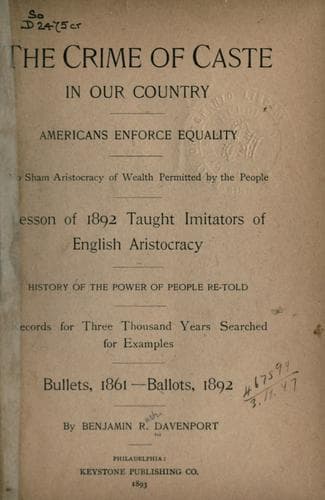
The Crime of Caste in Our CountryDavenport, Benjamin Rush
History
The Crime of Caste in Our Country
Davenport, Benjamin Rush
Social problems; United States -- Social conditions -- 1865-1918
DIED DECEMBER, 1892, WORTH $70,000,000.]
“What a different social vista is presented to us when we turn
to look back on the long and peaceful life of _Emerson’s widow_,
who died last week at the ripe age of _ninety_. Although she made
no claim on the world’s regard, we catch pleasant glimpses of
her personality along the path of the great philosopher’s life,
like the sunshine showing through the leaves of the Concord elms.
Beside the simple dignity of a life like hers, how unsatisfactory
appears the career of an over-dressed, over-fed, over-rich woman
of fashion, worn out in the scramble and struggle to keep up with
the procession.”
The people desire, and have so expressed themselves, by the mighty
voice of the majority, a return to the simple, natural condition of
social life in America, wherein “caste” has no place, from which social
distinctions disappear; the simple, homely, every-day, virtuous life of
the mothers, wives, and daughters of those who made the Republic.
The “Common People” have recorded their protest against snobbery, sham
aristocracy, “smart sets,” Ward McAllister, and multi-millionaires, who
assume to be better, either by “divine right” or otherwise, than the
ordinary American citizen. They have taught, by the lesson preached
in the tremendous majorities for that party whom they deemed least
tainted with this repugnant crime, that wealth, arrogance, assumption,
and snobbery may have obtained an undue amount of influence,
disproportioned to its merit, but that, thank God, on election day,
every citizen of the Republic enjoys an equal right to the franchise,
and that, by the voice of the majority, he will create such laws as to
eradicate the insidious disease of “caste” from the wholesome body of
the nation.
CHAPTER VI.
THE ARISTOCRATIC “CHAPPIE” _vs._ ABRAHAM LINCOLN.
As that satellite of McAllister, that scion of the line of
“Patriarchs,” parades Fifth Avenue, creating by his presence an
aristocratic atmosphere for the poor, Common People to enjoy, what a
picture he presents! How admirable and worthy of emulation!
How the mind naturally recalls specimens of the _genus_ Chappie when
the subject of the young male aristocrat recurs to us! This descendant
of a half-dozen fur traders, ferrymen, or land speculators, has become
elongated and attenuated by the non-exercise of the muscles of his
feet and legs in the long tramps that his forefathers used to take to
barter for the peltries of the untutored Indian, exchanging rum and bad
muskets therefor.
Public-domain text, read in full here on John Shaqi.
Reviews
Reviews
No reviews yet
Be the first to share your thoughts on this work.
Elsewhere in the archive
Join the Discussion
Join the discussion
Sign in to leave a comment or review.
Sign InorCreate an account