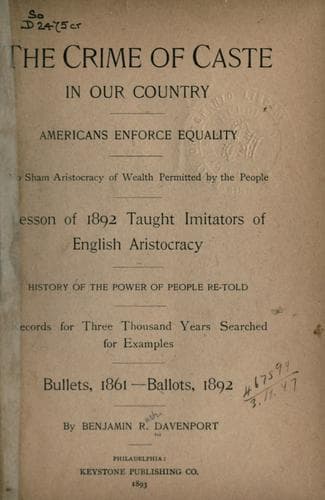
The Crime of Caste in Our CountryDavenport, Benjamin Rush
History
The Crime of Caste in Our Country
Davenport, Benjamin Rush
Social problems; United States -- Social conditions -- 1865-1918
We will begin with Chappie’s lower extremities, because of the greater
importance of that part of his anatomy. The pimple which surmounts
his structure is hardly worthy to be called a head, and is the least
important part of his makeup. Around the thin shanks of his lower limbs
are imported striped trousers, in imitation of his English model; these
are turned up when it rains in London. His narrow, chicken-like bosom
is covered by a hand’s breadth of imported material. (There’s no heart
in his bosom, nor other organs worthy of naming within his whole body;
hence, a little cloth will cover his trunk.) From sloping shoulders
that would have done credit to a belle of the First Empire of France,
hangs, in badly wrinkled folds, the latest thing “from Poole’s, of
London, y’ know!” Rising from the apex formed by the slopes of his
shoulders is a thing through which he breathes, and which he calls a
neck; around which, to fence it from the cold blasts of heaven, he has
had built a structure which he calls a collar, modelled absolutely
after that of “our late lamented Prince Clarence.” Above that thing
he calls a neck is nothing; for that which in a human being would
represent a face, in this creature is but a simpering mask of idiocy,
arrogance, sensuality, intemperance, and licentiousness.
That thing he calls a face, with assured presumption and insulting
attitude, he thrusts before the gaze and upon the attention of the
daughters of the poor but honest workmen, whose children, not having
a fur trader for a grandfather, have to labor. This _thing_--this
“Chappie”--would assume the same privileges as one of the new nobility,
the creation of men like McAllister and the “Patriarchs,” as those
assumed by the curled and perfumed darlings of the court which
surrounded the licentious Louis XV. That which from fear he would not
dare to do or say among the “smart set,” he feels at liberty to do or
say when thrown among the children of the poor and defenceless on a
public street. It is nothing to him to insult the poor shop girl; he
would say, “That is one of the evidences that I am of the upper class.
It should be an honor to be spoken to by me.”
It was ever one of the idiosyncrasies of the upper classes, wherever
people have allowed them to exist, to insult innocence and outrage
honor. History teems with it, and “Chappie,” by tradition, thinks
that necessarily he must act it, to be of the “Prince’s set.”
“Chappie” thinks that the scandal of Cavendish Square was but a little
episode--nothing, in fact, because the children of the poor were the
only ones contaminated; for the brutes who led to these orgies in
Cavendish Square had already become decayed and rotten morally.
Public-domain text, read in full here on John Shaqi.
Reviews
Reviews
No reviews yet
Be the first to share your thoughts on this work.
Elsewhere in the archive
Join the Discussion
Join the discussion
Sign in to leave a comment or review.
Sign InorCreate an account