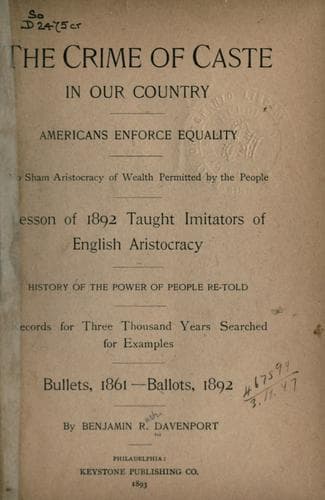
The Crime of Caste in Our CountryDavenport, Benjamin Rush
History
The Crime of Caste in Our Country
Davenport, Benjamin Rush
Social problems; United States -- Social conditions -- 1865-1918
While Mr. Walker has taken Homestead for his text, the application of
his article to the condition of the people of the Union generally is
so apparent that each man for himself may shift the scene and make
it applicable to his own little community. In every village, town,
city, or county in the Union, is some one man, or some set of men,
who arrogate to themselves a certain superiority resulting from the
accumulation of wealth in their hands; this accumulation, having arisen
from the inequality in the distribution of the increased wealth of
the nation, being in many cases purely accidental, and in others the
result of the phenomenal development of the resources of this country,
coupled with the wonderful spirit of invention shown in the land in
the last thirty years. Mr. Walker takes Carnegie and Frick as types of
the class to which the people object so strenuously. The building of a
church, or the founding of a library, is but a small price to pay, in
the opinion of the American people, for the right to assume privileges
detrimental to the growth and continuance of that doctrine so dear to
the hearts of the masses--the equality of man. Mr. Walker entitles his
article, “The Homestead Object Lesson,” and begins by saying:--
“An affair like that at Homestead educates the public mind
rapidly; more rapidly in a month than ten years of books and
pamphlets. In the face of death, men stop to think. What led to
this? What does it mean? What is the remedy? And when the daily
journal gives in one column the picture of Cluny Castle, or the
magnificent pile from which the Lyttons have gone out to admit
partner Phipps from the Homestead mills, and in another sketches
showing the dead and dying upon the banks of the Monongahela, the
contrast is so sharp that one draws a quick breath of discomfort,
and even the most conservative, whose manhood is stronger than his
love of dollars, admits that something is wrong.”
If a man in the walk of life of Mr. Walker shall “draw a quick breath
of discomfort” at the scene he pictures, because his “manhood is
stronger than his love of dollars,” how utterly obvious it ought to
have appeared, and should now appear, to those possessed of wealth,
that an appeal for the support of that class who, as American citizens,
not only possess an abundance of manhood, but, in addition thereto, are
sufferers by the wrongs or conditions written of by Mr. Walker, was and
is useless.
Public-domain text, read in full here on John Shaqi.
Reviews
Reviews
No reviews yet
Be the first to share your thoughts on this work.
Elsewhere in the archive
Join the Discussion
Join the discussion
Sign in to leave a comment or review.
Sign InorCreate an account