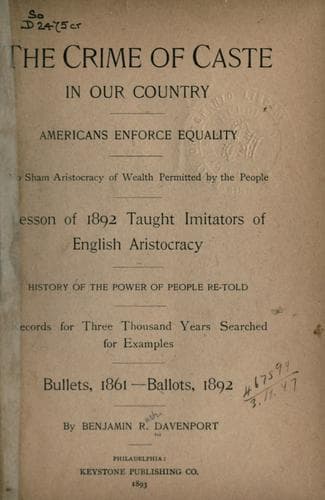
The Crime of Caste in Our CountryDavenport, Benjamin Rush
History
The Crime of Caste in Our Country
Davenport, Benjamin Rush
Social problems; United States -- Social conditions -- 1865-1918
“Lovers of the Republic may well tremble at this exhibition, so
closely resembling the evil days when rich Romans surrounded
themselves by hired bands of fighting bullies. True, our
modern rich man does not parade the streets, surrounded by his
gladiators. He sits in a secret office, removed from danger,
and, in communication with the telegraph wires, orders his army
concentrated from many States by rapid transit, and moves it
unexpectedly upon his private foes. There is lacking that personal
courage which gave a half-way excuse to the Roman who, sword
in hand, shared the dangers of the fight. But the risk to the
Republic is all the greater from these modern methods. For, if a
man may hire 300 poor devils ready to shoot down their brothers in
misery, there is no reason why he may not hire 10,000.”
There are not a few of us who will recall the natural indignation
aroused in our bosoms while witnessing that noble impersonator of
_Virginius_, John B. McCullough; the idea of the degradation to
which we were drifting, by the possibility of the existence of an
aristocracy, whose hired bullies and parasitical clients acted as
panders to the worst passions of man. If it be possible to adopt the
old Roman method of hiring bullies and assassins, and maintaining paid
private armies, how very possible to come to a condition similar to
that so powerfully portrayed in _Virginius_! Lovers of the Republic,
of honor, and virtue, may well tremble, at the bare possibility,
vaguely imagined, but evidently more vivid to the minds of the masses,
than was contemplated by those autocratic gentlemen who ordered their
mercenaries to Homestead.
“There is another side to this matter. Raised up under the system
which declares that any man has a right to control, without limit,
the earth’s surface and its productions, or the labor of his
fellow-men, Mr. Frick, doubtless, feels that he is performing a
sacred duty in protecting his property at Homestead, by any means
that the law permits. Thousands of good men held the same thought
regarding their slaves, before and during the war. It really
seemed to them a divine right of property, and all classes of the
community to-day--learned ministers and professors, intelligent
merchants, and high-minded men of all professions--hold that our
system of distribution is not only legal, but fair, and authorized
by the teachings of the Gospel.”
In the most lucid manner, Mr. Walker continues to give the causes of
the existence of conditions conducive to the results which have been
produced by the accumulation of wealth, and, in consequence, assumption
of a superior social position by the possessors thereof:--
Public-domain text, read in full here on John Shaqi.
Reviews
Reviews
No reviews yet
Be the first to share your thoughts on this work.
Elsewhere in the archive
Join the Discussion
Join the discussion
Sign in to leave a comment or review.
Sign InorCreate an account