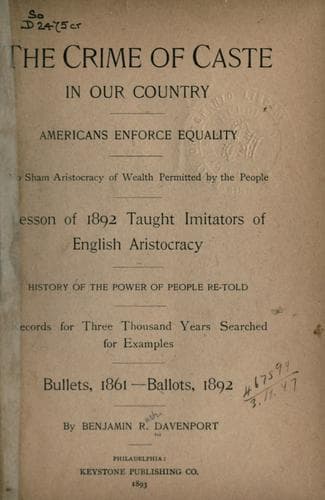
The Crime of Caste in Our CountryDavenport, Benjamin Rush
History
The Crime of Caste in Our Country
Davenport, Benjamin Rush
Social problems; United States -- Social conditions -- 1865-1918
“Less than half a century ago the people of the United States were
comparatively poor and the wealth of the country distributed with
a near approach to equality, less than a dozen individuals having
fortunes approaching the million mark. The laws had been made
for the existing conditions of labor, and were, as a whole, of a
satisfactory character. No one had yet dreamed of the marvelous
inventions and discoveries of natural wealth which were to upset
all the conditions of production, and make the succeeding fifty
years a wealth-giving period, unprecedented in the history of the
world. Anthracite and bituminous coals, petroleum, the cotton gin,
the reaper, steam and electricity, with their thousand marvels,
were suddenly emptied upon a community whose laws had been made
for conditions the very opposite of those now existing.
“It is not to be wondered at that the American mind should seize
upon the possibilities which old laws gave to individuals for
grabbing these newfound treasures. They would have been more than
human if they could have resisted the temptation, and besides,
it must be recollected that the Christianity practised was of a
perfunctory character, formal and nominal rather than real, and
civilization just beyond the period of wild beast skin wearing.
In fifty years the creation of wealth has become prodigious; the
distribution of wealth has become frightful in its inequalities.
The laws, which were beneficent for an agricultural and pastoral
people, worked degradation and infamy in a manufacturing
community. They permitted the few to grab the greater part of
this new wealth. With great fortunes are coming upon the scene
an unparalleled luxury upon the one hand, and a poverty upon the
other, scarcely surpassed in the days when production did not
equal one-tenth the present output. In the strife for wealth
the law-making power was found to be a useful auxiliary. Judges
were bought, senatorships were sold in the interests of railways
and the great corporations; and within the last ten years we
find wealth--not contented with the advantages which the laws,
confessedly in its favor, give it--hiring private armies to give
force to edicts allotting to the laborer a lesser share of the
product.”
Experience and observation force the conviction upon our minds, that
Mr. Walker is correct in his assumption that even the ministers believe
that the distribution of wealth among the masses is not only legal, but
fair, and authorized by the teachings of the Gospel. A little strange,
however, is it for the teachers of the doctrine of Christianity to
maintain principles so utterly at variance with those expressed by
their divine Master: “If thou wilt be perfect, go and sell that thou
hast, and give to the poor.”
Public-domain text, read in full here on John Shaqi.
Reviews
Reviews
No reviews yet
Be the first to share your thoughts on this work.
Elsewhere in the archive
Join the Discussion
Join the discussion
Sign in to leave a comment or review.
Sign InorCreate an account