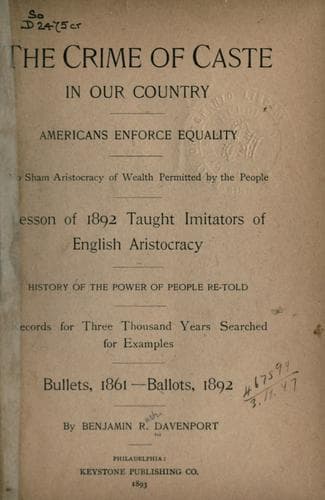
The Crime of Caste in Our CountryDavenport, Benjamin Rush
History
The Crime of Caste in Our Country
Davenport, Benjamin Rush
Social problems; United States -- Social conditions -- 1865-1918
Fortunately, Mr. Walker’s prophecy has proved incorrect. There was a
time in the very near future when the objects so sacred to them would
outweigh any possible advantage that might accrue to their pocketbooks
by voting with those who would impose the yoke of a class distinction
upon our country. It was nearer the day of retribution than even Mr.
Walker, farseeing as he has demonstrated himself to be, supposed.
The 8th of November was to witness the vindication upon the part of
the workman of his inherent right to exercise his prerogative as an
American citizen, uninfluenced by mercenary motives. Almost without
an error has Mr. Walker gauged the public feeling. It is pardonable,
in one who is so much nearer right than the majority, to make one
single error. None of us appreciated how full were the hearts of the
workingmen, the poor, and those oppressed by wealth and stung by an
attempted exhibition of the privileges accorded to “caste.”
“Nevertheless, there is a ground-current steadily moving
across the continent. Workmen, who were wholly ignorant thirty
years ago, are partly educated to-day. Within fifteen years,
a highly-intelligent class has sprung up among the workmen
themselves, and there are a few really able men who have been
making efforts for their advancement. That man Powderly, for
instance, is a statesman of a high order. He has capacity for
organization, he has singleness of purpose, he has determination,
and he has courage. And he is only one of a number. They have been
educating their followers, and teaching them to unite upon certain
simple propositions. It is like the fencing-master, who puts in
the hands of his pupil the single-stick, before he confides to
him the glittering rapier. There is talent enough among them to
organize a movement more formidable than that of Spartacus. Thank
God, they are men who love the Republic, and who hope for the
elevation of their people through the evolution of the law.”
Public-domain text, read in full here on John Shaqi.
Reviews
Reviews
No reviews yet
Be the first to share your thoughts on this work.
Elsewhere in the archive
Join the Discussion
Join the discussion
Sign in to leave a comment or review.
Sign InorCreate an account