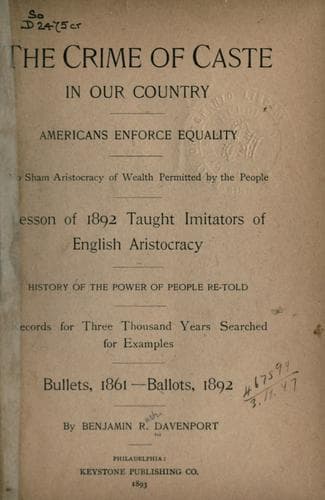
The Crime of Caste in Our CountryDavenport, Benjamin Rush
History
The Crime of Caste in Our Country
Davenport, Benjamin Rush
Social problems; United States -- Social conditions -- 1865-1918
Mr. Walker could have gone on and called the attention of the wealthy
to the fact that, while these men loved the Republic, they did not love
the foreign spirit that pervaded the would-be upper classes. It is well
that a man of Mr. Walker’s position should feel it incumbent upon him
to compliment, or, more properly speaking, to duly appreciate, a man
like Powderly. Mr. Powderly, were he not a statesman and a patriot,
is possessed of dangerous powers; were it not for the great amount of
virtue, honesty, and common-sense that resides in the bosoms of the
masses, some dangerous, daring, and magnetic leader might spring into
prominence and cause the overturning which Mr. Walker so ably depicts
later in his article. Mr. Powderly, and men of his kind, have ever
acted as the governing-power on this tremendous engine, called Labor,
in this country. They have exhibited a degree of conservatism and
consideration for the rights of the wealthy, as well as the rights of
the laborer, which entitles them to the respect of all sound-minded
Americans.
“Two things must always be borne in mind: First, that the laboring
men have the majority, if they choose to exercise it, not only of
votes, but of physical strength. Intelligence and cunning were,
once upon a time, factors upon which the few rich could count to
keep in subjection the many poor. The time is rapidly approaching
when these will no longer avail. There is a prevailing thought
that this must be a Republic, indeed, where all men shall be equal
before the law; where the law will carefully guard the industrious
man against the greedy man; where cunning will not place labor at
the greatest of disadvantages; where labor will become honorable,
and idleness contemptible; where effort will be expected from
every citizen in the direction of his best talent, and where
the needs of the unfortunate, through disease or inheritance,
will be respected; in a word, the model government in which a
near approach to the ideal Republic will be attained, an example
set which the countries of Europe may well imitate. We have the
opportunities here, with our rich territory, our great natural
resources, and our population yet uncrowded, to do this. If we
fail, the idea of a Republic may well be abandoned for the next
2,000 years.”
Public-domain text, read in full here on John Shaqi.
Reviews
Reviews
No reviews yet
Be the first to share your thoughts on this work.
Elsewhere in the archive
Join the Discussion
Join the discussion
Sign in to leave a comment or review.
Sign InorCreate an account