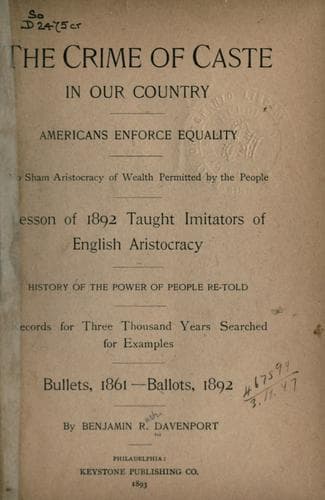
The Crime of Caste in Our CountryDavenport, Benjamin Rush
History
The Crime of Caste in Our Country
Davenport, Benjamin Rush
Social problems; United States -- Social conditions -- 1865-1918
the full complement of ten companies of seventy men each, with as
many more left over for onlookers at parades. Six months of hard
drill such as the enthusiasm of these men would permit would leave
them equal to the best of the Philadelphia troops. Does anyone
believe for an instant that if there had been a hundred such
regiments among the workingmen of Pittsburg, General Snowden would
have declared that he could not recognize the existence of such a
body of men as the Amalgamated Association?”
We will assume, with Mr. Walker, that the commandant of the troops
sent to Pittsburg by the Governor of Pennsylvania, was a “gentleman
bred.” About a man being _born_ a gentleman, we may hold opinions at
variance with Mr. Walker. Horses may exhibit the fact that they are
thoroughbred, when intelligence in the shape of a jockey is perched
upon their backs; but born gentlemen in America have never, as a rule,
by their scintillating genius and danger-defying patriotism, carved out
names upon the eternal monuments of the nation to rival the names of
Clay, Webster, and Lincoln. We hope that the man put in command of the
Pennsylvania militia was a “gentleman bred,” but the exhibition that he
made of himself, while clothed with that brief authority, would not be
conducive to the formation of such an opinion.
In his meeting with the citizens of the Commonwealth of Pennsylvania,
who were contributing towards the payment of the taxes from which the
expenses incurred by the State were to be defrayed, he did not conduct
himself in a manner such as to make a shining example for those who
shall command, in the future, the citizen-soldiery of the Republic. He
seemed utterly oblivious to the fact that he came, not as a conquering
hero, but as a private citizen, invested with a brief and circumscribed
authority exercised for the greatest good to the greatest number in
the prevention of lawlessness and violence and the peaceful solution
of a local difficulty with which the Sheriff of the county appeared
to be unable to contend. The arrogance assumed by this “gentleman
bred” was not calculated to create any great amount of good feeling
in the breasts of his fellow-citizens, to pacify whom he was sent
by the Governor of his State. There would have been but slight loss
of dignity upon his part to have allayed their anxiety by a little
exercise of that “good breeding,” patience, and consideration for the
feelings of others, which are supposed to be characteristics of the
gentleman the world over. General Ulysses S. Grant, commander of the
armies of the nation, as victor in a contest of four years’ duration,
has set a magnificent example in the treatment of his vanquished but
great opponent, Lee, by his courteous, kindly, and magnanimous behavior
toward Lee and his vanquished legions whom Grant had so long faced and
at last vanquished.
Public-domain text, read in full here on John Shaqi.
Reviews
Reviews
No reviews yet
Be the first to share your thoughts on this work.
Elsewhere in the archive
Join the Discussion
Join the discussion
Sign in to leave a comment or review.
Sign InorCreate an account