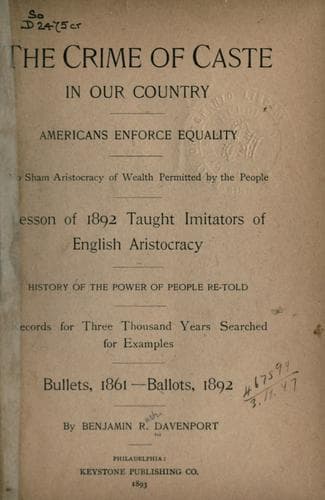
The Crime of Caste in Our CountryDavenport, Benjamin Rush
History
The Crime of Caste in Our Country
Davenport, Benjamin Rush
Social problems; United States -- Social conditions -- 1865-1918
Forcefully is it called to the minds of the fortunate possessors of
wealth, by Mr. Walker, that the poor are in possession of a superior
physical force. It would be well for those who enjoy the protection
accorded to them and their property by this vast population, made up
largely of the laboring classes, to consider what a small percentage
the “wealthy” represent in the mass of 65,000,000 people. Their
pronounced minority becomes apparent whenever they oppose the will of
that great majority, the “Common People.” Should it ever be necessary
to arbitrate any question of difference by physical force, how
absolutely unequal are the contending elements! Men like Mr. Powderly
have ever sought to cast oil upon the turbulent waters occasioned
by too much arrogance upon the part of the wealthy. It is not only
equality before the law which the poor man prizes, but that equality
which is rather of a sentimental than a legal nature. He recognizes no
inequality as existing between the woman whom he honors as his wife
and the woman whom men like Messrs. Carnegie and Frick may clothe in
seal-skins and laces, and bedeck with jewels. It is not only before the
law that the poor man desires to be equal. The sentimental portion of
his nature is moved to create a difference, socially, resting only upon
those natural inherent qualities, worth, merit, and virtue, and not
that which has its foundation in the possession of wealth alone.
“That was a curious interview between the commandant of the
militia, the gentleman born and bred--with an inheritance of
belief regarding the rights to accumulate property, even if
in so doing one crowded one’s fellow-mortal to the wall--and
the iron-workers who constituted the Homestead committee.
Gold-spectacled, practised in the art of snubbing and sure of the
physical strength at his back, the officer was more than a match
for the laborer, who in his turn was awed by his inherited respect
for wealth and power. Chilled and overawed, the representatives of
labor went down the hill from this unequal interview. The general
in charge had neither the grace nor the will to recognize a labor
association which embraced a membership large enough, if properly
organized, to sweep out of existence the entire army of the United
States. They must have reflected, as they went down the hill,
these representatives of labor, that if a militia organization
carried such weight, permitted such freezing dignity upon the
part of a citizen towards other citizens, it might possibly be
well for their interests to have a few thousand of their own men
enrolled in this same militia. There is nothing to prevent a body
of American citizens from organizing themselves as a militia
organization with proper arms and equipments. There are enough
workmen in Pittsburg and vicinity to give a hundred regiments of
Public-domain text, read in full here on John Shaqi.
Reviews
Reviews
No reviews yet
Be the first to share your thoughts on this work.
Elsewhere in the archive
Join the Discussion
Join the discussion
Sign in to leave a comment or review.
Sign InorCreate an account