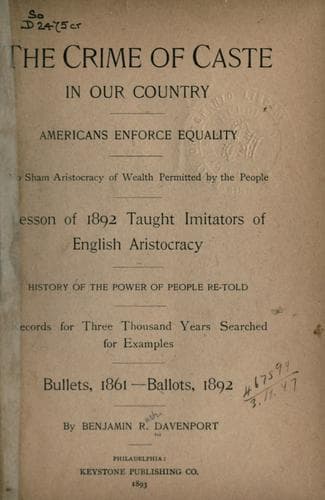
The Crime of Caste in Our CountryDavenport, Benjamin Rush
History
The Crime of Caste in Our Country
Davenport, Benjamin Rush
Social problems; United States -- Social conditions -- 1865-1918
It is not simply that those not possessed of wealth may live within
a few blocks of those who are possessed of wealth; it is not that
their lives may be eked out in darkness; it is the crushing shame to
them that their miserable existence is made still more hard to bear
by the flaunted superiority, socially, of the possessors of wealth,
who live a few blocks away. Poverty, when accompanied by none of the
other and more objectionable features, is not so hard to bear. The
poor man believes in the dignity of labor. He does not feel degraded
by the fact that he may toil with his hands. He only feels a sense of
shame, and his bosom only swells with wrath, when the disdainful dames
of the wealthy class presume to snub or insult his wife, the sharer of
his toil and privations. She is to him the light and life of even his
miserable hovel, only a few blocks away from the wealthy; hence, the
keener pang that he experiences when the one bright spot in his life,
sacred to him, is invaded by snobbery and pretended class distinction.
“Yet wise laws could regulate much of this in the brief period of
one generation. Lighten the burdens of taxation upon the poor,
by letting those whose wealth is protected by the State chiefly
furnish the means of subsistence for the State, at the same
time offering a discouragement to the amassing of great wealth.
The well-known expedient of income-tax would be a step in this
direction. Take out of the control of private individuals the
power to amass great fortunes, at the expense of the public,
through the management of functions like railway, express, and
telegraph, which are purely of a public character. Establish a
system of currency, self-regulated, by means of postal savings
banks; tax highly the unimproved properties which are held for
purposes of speculation. Finally, let it be a recognized principle
that when men employ many laborers, their business ceases to be
purely a private affair, but concerns the State, and that disputes
between proprietor and workmen must be submitted, not to the
brute-force of so many Pinkerton mercenaries, but to arbitration.”
Public-domain text, read in full here on John Shaqi.
Reviews
Reviews
No reviews yet
Be the first to share your thoughts on this work.
Elsewhere in the archive
Join the Discussion
Join the discussion
Sign in to leave a comment or review.
Sign InorCreate an account