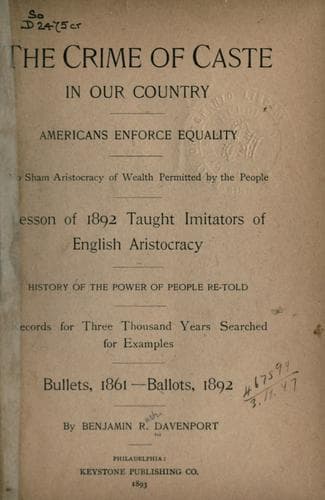
The Crime of Caste in Our CountryDavenport, Benjamin Rush
History
The Crime of Caste in Our Country
Davenport, Benjamin Rush
Social problems; United States -- Social conditions -- 1865-1918
Grover Cleveland is an exponent of that sentiment that made Abraham
Lincoln President in ’61; Jackson, President in ’28; Jefferson,
President in 1800. Call the party by whom he was nominated any name
that best suits the fancy of the speaker. It’s the same grand old,
broad party of the people; triumphant now as it ever will be, God
grant, in this Republic! We want no Republic in America like that of
Venice. The people have entrusted Grover Cleveland with the executive
power of the nation. At his hands they will expect the righting of
those wrongs which these petty tyrants, sham aristocrats, believers in
social distinction and “caste,” have inflicted upon the people. They
have chosen representatives in Congress who control both branches of
the legislature, through whom the people shall express their will and
pleasure; and the people will expect of Grover Cleveland, as they did
of Abraham Lincoln, Jackson, and Jefferson, the execution of their
wishes. The people have never been disappointed by the actions of their
former chieftains in this matter. When made chief magistrate of the
nation, every former leader of the people has executed the will of the
masses, according to the laws as enacted. No former chief magistrate
has ever presumed to use his power of veto contrary to the will of the
people as expressed by a majority of their representatives.
The eyes of the nation are upon Grover Cleveland. In return for the
defeat in their skirmish at Homestead, the people will expect to
reap the fruits of their victory in the great battle of ballots last
November. Long have they suffered, and now that the golden opportunity
has arrived, the people are not to be thwarted. With kindly but
scrutinizing gaze, the people regard their new leader, Grover Cleveland.
The New York _Sun_, of November 20th, in an account of the defeat of
the Amalgamated Association, prints the following:--
“A prominent member of the Association was seen at his house
this afternoon. His grate was piled high with burning pamphlets.
Pointing to them, he said:
“‘I have no more use for them. They contain the laws and rules of
the Amalgamated Association, and I have taken this means to be rid
of them. I hardly think the Amalgamated lodges will be continued
here, as nothing can be derived from membership in it. A potent
fact in losing the strike was that too many of our men returned to
work, and this helped the company to get its mills into working
order. It was not the company, but our own men, that lost the
strike.’”
Public-domain text, read in full here on John Shaqi.
Reviews
Reviews
No reviews yet
Be the first to share your thoughts on this work.
Elsewhere in the archive
Join the Discussion
Join the discussion
Sign in to leave a comment or review.
Sign InorCreate an account