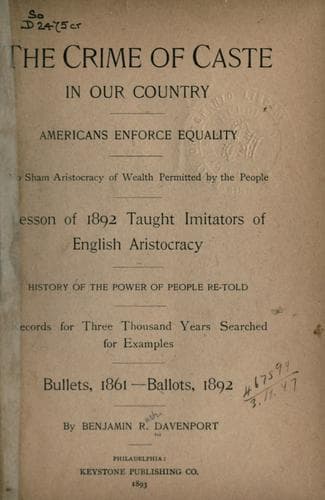
The Crime of Caste in Our CountryDavenport, Benjamin Rush
History
The Crime of Caste in Our Country
Davenport, Benjamin Rush
Social problems; United States -- Social conditions -- 1865-1918
This prominent member of the Association, who was engaged in burning
the laws and rules of the Amalgamated Association, was inadvertently
acting in accordance with the unexpressed thought that the people had
found a surer means of righting their wrongs than that furnished by
associated labor. They had learned that their power, when opposed to
the rich and aristocratic, was better utilized in the exercise of the
ballot than when expressed through associated labor and associations
of crafts and certain kinds of labor. If the Carnegies and Fricks were
wise, they would view with fear and trembling the disruption of this
thing called organized labor, which has been a toy by which the people
have been amused and entertained and diverted from the use of their
most effective weapon, the ballot.
Organized labor and association have proved a pretty tin toy sword,
which was attractive to gaze at upon a holiday parade, but utterly
valueless in actual warfare. Its absolute inefficiency was never more
clearly demonstrated, because it had never been so thoroughly tested in
any previous contest of labor, as at Homestead.
Here is given concisely--as that most excellent journal, the New York
_Sun_, always presents all matters of public interest--an account
of the cost of the strike to the laborers, to the capitalist, and
to the State of Pennsylvania. Even the most careless reader and the
most superficial inquirer after truth will read in this statement the
evidence of the brave and valiant battle made by labor, which was
defeated because the very sword it fought with was not of the kind of
metal for actual warfare. The Ballot! the Ballot! the Ballot! is the
weapon of the future:--
“It is almost impossible to give figures at this time on the
cost of the strike, but conservative estimates place it at about
$10,000,000. Of this, about $2,500,000 were in wages to the men.
The firm’s loss is thought to be two or three times that. The
direct cost of the troops was nearly half a million. The indirect
loss has been very large indeed.
“This contest was brought on by a demand for a reduction of wages
of about 33-1/3 per cent. on certain classes of work in the open
hearth departments, Nos. 1 and 2 mills, and in the 119-inch and
32-inch plate mills. This reduction directly affected only about
325 out of the 3,800 men in the works, but the others took up the
matter as a common cause through sympathy, and agreed to stand by
the men interested in case of a strike.
“The scale expired under which they were working on June 30th.
The company wanted the Amalgamated Association, which controlled
the workmen in the mills, to sign the scale at the reduction. The
scale was to be renewed on January 1st, instead of July 1st. The
Association refused, and the men threatened to strike should the
request for the existing scale not be granted before July.
Public-domain text, read in full here on John Shaqi.
Reviews
Reviews
No reviews yet
Be the first to share your thoughts on this work.
Elsewhere in the archive
Join the Discussion
Join the discussion
Sign in to leave a comment or review.
Sign InorCreate an account