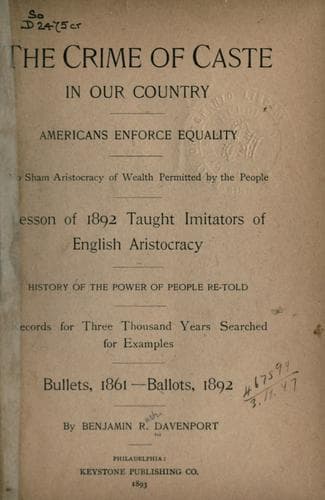
The Crime of Caste in Our CountryDavenport, Benjamin Rush
History
The Crime of Caste in Our Country
Davenport, Benjamin Rush
Social problems; United States -- Social conditions -- 1865-1918
Slumbering wrath was in the breasts of the people. One Robespierre or
Danton would have set aflame this feeling, and the “Common People”
only need a leader, an organizer who will teach them under form of law
that their mighty voice is paramount, and the sham aristocracy will be
crushed and annihilated, as was a better aristocracy in France in the
latter part of the eighteenth century. Don’t let history repeat itself.
Can such pictures as depicted in these few lines of the _Herald_ about
those poor children’s Thanksgiving dinner, the feast proposed by the
“Four Hundred” at Madison Square Garden, be accurate and represent
scenes in free America, the richest, freest, best country on earth?
or are these some occurrences seen in poor, starving, Czar-ridden
Russia? A bow of promise was in the sky that Thanksgiving Day,
however. The people had spoken a few days before. They had selected
their representatives to make laws relieving them of the presence of
such scenes as above described. They had selected an Executive of
unquestioned honesty, who will execute such laws as will emanate from
the representatives of the people.
The people had given no sign, but in silence had been thinking of
scenes like that proposed at Madison Square Garden. They had voted
November the 8th in silence.
Silence is often more dangerous than utterance. The deadly cobra gives
no signal before he strikes. “General apathy” and the silence of the
people was deadly earnest, and you know whether it was forceful or not.
And if the party that the people have put in power will not do the will
of the people, then the people will put some other party in power which
_will_ execute the desire of the masses. It is a quicksand that the
rich tread upon. So accustomed have the rich become to the patience,
long-enduring suffering of the poor, that they deem it impossible that
any condition could exist other than the present. Only remember that
Charles Stuart, Louis XVI., Tarquin, all thought it was impossible
that aught could interfere with the set order of things; but righteous
indignation, the wrath of the people, like a whirlwind may obliterate
the little edifices of dust built upon the past.
The rest of the story, so vividly portrayed by the _Herald_, is worthy
of consideration and attention:--
“I visited the house of J. W. Grimes, a striker, on the hillside,
above the mill. He had a pair of rubbers on his feet. The rubbers
were worn away and had been sewed together with twine. ‘You see,
my shoes are so bad,’ said the mill-man, apologetically, ‘that I
have to wear these rubbers. Jim Sweeney threw them away, but I
found them and sewed them up,’ and he exhibited a shoe that would
almost have fallen from his foot, but for the rubber which held it.
Public-domain text, read in full here on John Shaqi.
Reviews
Reviews
No reviews yet
Be the first to share your thoughts on this work.
Elsewhere in the archive
Join the Discussion
Join the discussion
Sign in to leave a comment or review.
Sign InorCreate an account