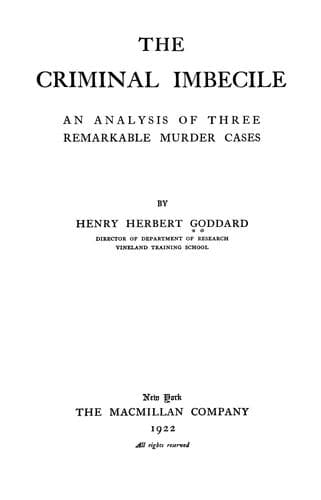
The Criminal Imbecile: An Analysis of Three Remarkable Murder CasesGoddard, Henry Herbert
Science
The Criminal Imbecile: An Analysis of Three Remarkable Murder Cases
Goddard, Henry Herbert
Crime -- Case studies; Murder -- Case studies; Offenders with mental disabilities -- Case studies
There is the highest probability, perfectly clear to one who understands
imbeciles, that almost from the time the deed was done he had a strong
desire to tell somebody about it, to brag about it; but a certain
instinct, a certain feeling that he ought not to be caught, probably held
him back. But when at last he was taken back to Poland and into the
presence of the Deputy Sheriff; when his clothes had been removed and he
thought his story would get into the papers and he would become notorious;
then he began to talk. In spite of all the warnings and declarations that
he would suffer for it, he talked. At this point it is important to
remember that he is talking now to be heard; he is not confessing in order
to escape punishment, he is talking because he is proud of what he has
done; he wants to boast, wants to be talked about and written up, wants to
be notorious, a great criminal, as is evidenced in the course of the
trial. Remembering this, we _cannot believe all that he says in his
confession_.
As already stated, in so far as it relates to the basal facts of the
crime, it is undoubtedly true; but when it comes to the finer details of
what he did, how he prepared, and what he claimed was his motive, we
greatly err if we accept everything he said. It is not in the sworn
confession, but it was in evidence that he said he sharpened the knife for
the purpose; the fact that he said he sharpened the knife for the purpose
should have no weight. It is precisely the kind of thing that he would put
in for effect. In fact all that he said after the deed as to arrangements
or plans or details must ever be questioned unless his statements can in
some way be corroborated, for this tendency to elaborate is so strong that
there is no possibility of putting any trust in his words.
It is worthy of note that whereas the defense introduced many witnesses
who testified to Jean's sayings and actions that showed silliness and
indicated childish intelligence, the prosecution neither rebutted this nor
produced witnesses testifying to anything in his previous conduct that
gave evidence of good judgment or intelligence appropriate to his years,
or that he had any moral development that would be normal for his age.[1]
The evidences of his pride in the deed are scattered throughout the
testimony. For example, at one time he said, referring to the deed, "You
would not think anybody could do a deed like that so quick, would you?"
When asked how he could get Miss Beecher to go so far up the hill in the
dark with him, he replied with a good deal of pride: "That's easy! I told
her my father was building a house up on the hill and we went up there."
Public-domain text, read in full here on John Shaqi.
Reviews
Reviews
No reviews yet
Be the first to share your thoughts on this work.
Join the Discussion
Join the discussion
Sign in to leave a comment or review.
Sign InorCreate an account