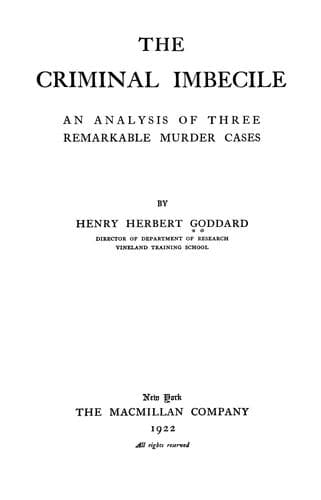
The Criminal Imbecile: An Analysis of Three Remarkable Murder CasesGoddard, Henry Herbert
Science
The Criminal Imbecile: An Analysis of Three Remarkable Murder Cases
Goddard, Henry Herbert
Crime -- Case studies; Murder -- Case studies; Offenders with mental disabilities -- Case studies
the evidence he struck her with the knife approximately twenty-four times,
finally hitting the jugular vein in the neck, as a result of which she
probably bled to death.
As already stated, the writer has no desire to advance this as _the
theory_ of the deed. But if Jean is an imbecile, this theory is fully as
good as that upon which the prosecution worked, and it eliminates entirely
all necessity for elaborate planning. Up to this point we have shown that
the fact of a confession and the character of the confession, both
difficult to explain on the basis that Jean is a normal boy of sixteen,
are entirely clear and perfectly characteristic of a high-grade imbecile.
Let us look now at his actions immediately after the deed. It is in
evidence that Jean said he took the murdered girl by the foot because
there was no blood there and he did not want to get blood on his hands for
fear they would take his finger prints. Holding her by the foot, he
dragged her out of the road behind some bushes and left her in the snow.
He then went back into the road, making new tracks, which he made no
effort to cover. Nor did he make any effort to cover the old tracks or the
blood spots that were left along in the snow. Neither did he make any
attempt to hide the hat nor the umbrella nor the broken comb which were
left in the road; his care to take her by the foot where there was no
blood is cited as evidence of forethought and judgment; but what shall we
say of his failure to cover up his tracks when it was easy to have done
so!
Again we must remind the reader that we have nothing but the boy's
testimony as to the fact that he took her by the foot or to explain why he
took her by the foot, but in accepting his testimony as true there is
nothing incompatible with high-grade imbecility.
The one peculiar thing about Jean is that he has read more than most
imbeciles even of this high grade. But this peculiarity does not save him
from being an imbecile, since there are cases of imbeciles who have read
as much or even more than he. Furthermore, there is plenty of evidence in
the case that Jean's interest in reading has gone along the line,
childlike, of crime. The various experts who examined him told of his
talking about the case of the New York gunmen, of the Pomeroy case, of a
murder in the South, and possibly others. He inquired about Mahoney, the
would-be assassin of Mayor Mitchell. In connection with these crimes his
reading of finger prints had made the same impression upon him that it
would have upon any boy. He remembered what he had read and perhaps acted
upon it, at least talked about it when the opportunity came, and pretended
that he considered it in his action.
Public-domain text, read in full here on John Shaqi.
Reviews
Reviews
No reviews yet
Be the first to share your thoughts on this work.
Join the Discussion
Join the discussion
Sign in to leave a comment or review.
Sign InorCreate an account