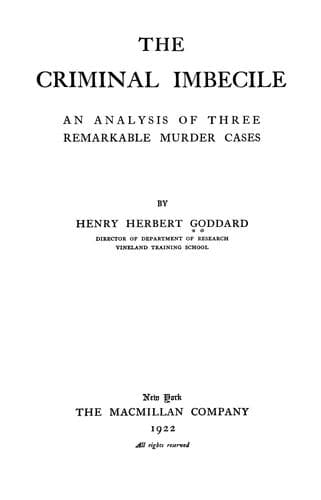
The Criminal Imbecile: An Analysis of Three Remarkable Murder CasesGoddard, Henry Herbert
Science
The Criminal Imbecile: An Analysis of Three Remarkable Murder Cases
Goddard, Henry Herbert
Crime -- Case studies; Murder -- Case studies; Offenders with mental disabilities -- Case studies
Not infrequently have verdicts in murder trials been unacceptable to the
populace. In that respect this verdict is not an exceptional one, but from
other standpoints it is remarkable. Probably no verdict in modern times
has marked so great a step forward in society's treatment of the
wrongdoer. For the first time in history psychological tests of
intelligence have been admitted into court and the mentality of the
accused established on the basis of these facts.
The value of this verdict cannot be overestimated. It establishes a new
standard in criminal procedure. It recognizes that _weakness_ of mind, as
an excuse for crime, is of the same importance as _disease_ of mind; puts
feeble-mindedness in the same category with insanity, and requires that it
like insanity be considered in all discussions of responsibility. When we
add the now accepted fact that the feeble-minded are at least as numerous
as the insane, we see the far-reaching significance of this standard set
by the Supreme Court of Herkimer County, New York.
That the verdict has not been at once acceptable to the people is due to
the fact that the character and the limitations of the high-grade
imbecile are not understood. With a view to explaining this type of
defective, which the defendant so well illustrates, we propose in the
following pages to go over the history of this case, explaining the facts
in the light of present-day knowledge of the feeble-minded.
The facts in the case as established by testimony:--
On the morning of March 28th, 1914, Henry Fitch, a farmer of Herkimer
County, accompanied by his son, started on his usual work to deliver milk.
At a point in the highway, approximately one mile from the village of
Poland, Mr. Fitch saw blood and signs of a struggle in the snow and slush
in the road; he also found an umbrella and a hat. A bloody path led out of
the road to a point some hundred and thirty feet away. Following the
tracks he found the body, which proved to be that of Lida Beecher, one of
the school-teachers in the village of Poland. She lay at full length on
her face, both arms under her. The body was removed to Sprague's
undertaking rooms in the village.
Public-domain text, read in full here on John Shaqi.
Reviews
Reviews
No reviews yet
Be the first to share your thoughts on this work.
Join the Discussion
Join the discussion
Sign in to leave a comment or review.
Sign InorCreate an account