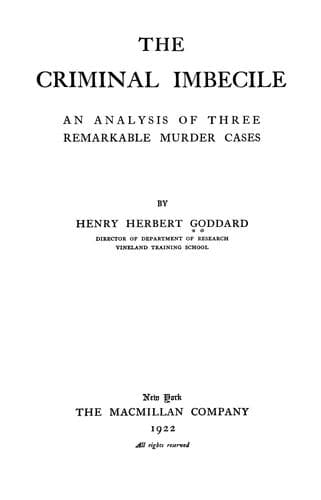
The Criminal Imbecile: An Analysis of Three Remarkable Murder CasesGoddard, Henry Herbert
Science
The Criminal Imbecile: An Analysis of Three Remarkable Murder Cases
Goddard, Henry Herbert
Crime -- Case studies; Murder -- Case studies; Offenders with mental disabilities -- Case studies
We have already given all that is known of the circumstances except
certain details which Jean claimed in his confession, and certain acts and
utterances which were testified to by local witnesses.
We may now examine these testimonies, reserving his confession for a later
discussion. So far as the crime itself is concerned but little testimony
was brought forward; so little, in fact, that without the boy's confession
he probably could never have been convicted of the deed.
On the evening of the tragedy Jean was seen by several people walking up
the street toward his home in company with his victim. Two days before
this he had been heard to ask her when she was coming to see his father
about his returning to school; to this she had replied, that she "did not
know"; and he had answered, "Aw, I don't believe you intend to come at
all, you will wait until summer time, and go home and then it will be too
late." On the following evening he again asked her to go up to his house.
She said she could not go then, as she was going to prayer meeting, but
she would go the next night. He had also inquired of certain persons
whether she went to the Post Office in the evening. On one occasion he
had been seen with an old rusty wrench in his pocket and when asked what
he was doing with it, he had replied, "I have use for it." This was the
wrench with which he struck his victim the death-blow, according to his
confession.
Previous to the tragedy he had told certain persons that he meant to get
even with Miss Beecher. The wrongs for which he claimed to have desired
revenge had occurred more than a year before the tragedy. For over a year
he had been out of school and had been working a part of that time. For
some months he had been an inmate of St. Vincent's School, to which
institution he was committed by a Justice of the Peace at the instigation
of his father because of his propensity to jump freight trains.
The evidence was strongly against the idea that Miss Beecher had ever done
anything to injure him or anything which would reasonably cause resentment
in his mind. He had not gotten along well in his studies after going into
her room, had been more or less disorderly, and she, at the suggestion of
the principal, had seated him facing the wall with his back to the rest of
the school. She had occasionally sent him up to the principal, who had
sometimes flogged him.
Public-domain text, read in full here on John Shaqi.
Reviews
Reviews
No reviews yet
Be the first to share your thoughts on this work.
Join the Discussion
Join the discussion
Sign in to leave a comment or review.
Sign InorCreate an account