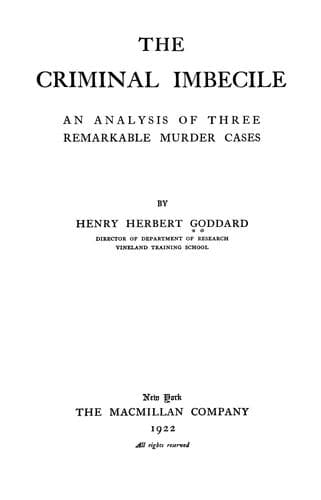
The Criminal Imbecile: An Analysis of Three Remarkable Murder CasesGoddard, Henry Herbert
Science
The Criminal Imbecile: An Analysis of Three Remarkable Murder Cases
Goddard, Henry Herbert
Crime -- Case studies; Murder -- Case studies; Offenders with mental disabilities -- Case studies
Defendant requests your Honor to charge the jury that if, at the time of
the commission of the act, the defendant was under the influence of a
diseased mind, and was really unconscious that he was committing a crime,
this defendant must be acquitted.
XV
Defendant requests your Honor to charge the jury that the insanity of the
defendant need not be proven beyond a reasonable doubt.
XVI
Defendant requests your Honor to charge that the jury, in considering this
case, are bound to act upon the presumption that the accused, the
defendant, is innocent, and should endeavor, if possible, to reconcile all
the circumstances of the case with that of innocence.
XVII
Defendant requests your Honor to charge the jury that the burden of proof
rests with the commonwealth in this case, from the beginning to the end of
the trial, and the commonwealth are bound to prove that the defendant
committed the crime charged in the indictment beyond a reasonable doubt,
otherwise the defendant is entitled to be acquitted.
XVIII
Defendant requests your Honor to charge that the jury must be satisfied
beyond a reasonable doubt, from the evidence of the case, of the sanity of
the defendant at the time of the commission of the act charged in the
indictment, and if the people fail to establish the sanity of the
defendant at the time of the commission of the act charged in the
indictment, this defendant cannot be convicted of any crime and is
entitled to an acquittal.
XIX
Defendant requests your Honor to charge the jury that the law does not
require that the insanity, imbecility, or mental aberration which absolves
from crime should exist for any definite period, and only that it existed
at the moment when the act occurred.
XX
Defendant requests your Honor to charge the jury that if the insanity,
imbecility, or mental aberration which absolves from crime operated at the
moment that the act was committed, that is sufficient in law to absolve
from guilt, and this defendant cannot be convicted of the offense charged
in the indictment, or any other offense.
XXI
Defendant requests your Honor to charge the jury that the commonwealth
must satisfy the jury beyond all reasonable doubt, that, at the moment
the act alleged in the indictment was committed by the defendant, he had
reason, perception, and understanding sufficient to enable him to discern
right from wrong, and that if he had not, it is the duty of the jury to
acquit this defendant.
XXII
Defendant requests your Honor to charge that if the jury believe that the
defendant did not suffer from any mental aberration which would absolve
him from punishment for the act charged in the indictment prior to the
commission of the act, or subsequent thereto, but that such state of
mental aberration did exist at the moment when the act occurred which the
defendant stands charged with, this defendant cannot be convicted of the
crime charged in the indictment, or any other crime, and must be
acquitted.
XXIII
Public-domain text, read in full here on John Shaqi.
Reviews
Reviews
No reviews yet
Be the first to share your thoughts on this work.
Elsewhere in the archive
Join the Discussion
Join the discussion
Sign in to leave a comment or review.
Sign InorCreate an account