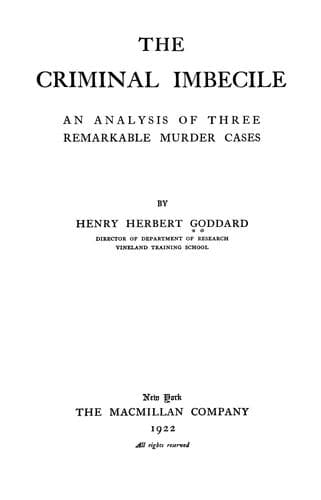
The Criminal Imbecile: An Analysis of Three Remarkable Murder CasesGoddard, Henry Herbert
Science
The Criminal Imbecile: An Analysis of Three Remarkable Murder Cases
Goddard, Henry Herbert
Crime -- Case studies; Murder -- Case studies; Offenders with mental disabilities -- Case studies
Defendant requests your Honor to charge the jury that if there is a
reasonable doubt in the minds of the jury as to whether the act charged in
the indictment was committed by the defendant while he was unable to
discern between right and wrong, or if the evidence is equally balanced
as to this, so that the jury cannot safely and conscientiously determine
whether the killing of the deceased was intentional, or was committed by
the defendant while he was unable to discern between right and wrong with
respect to the act, then this defendant is entitled to the benefit of that
doubt and entitled to an acquittal.
XXIV
Defendant requests your Honor to charge the jury that if it finds that the
defendant is of a mental age of under twelve years, he is presumed to be
incapable of the commission of crime. (_Refused_)
XXV
Defendant requests your Honor to charge the jury that if it finds that the
defendant is of a mental age of under twelve years, he is presumed to be
incapable of crime and that presumption is not removed by proof that he
had sufficient capacity to understand the act charged against him and know
its wrongfulness, except by evidence that satisfied the jury beyond a
reasonable doubt. (_Refused_)
XXVI
Defendant requests your Honor to charge that if the jury finds that the
defendant is of a mental age of under twelve years, the evidence that he
understood the nature or quality of the act charged against him and knew
its wrongfulness must be strong and clear beyond a reasonable doubt.
XXVII
Defendant requests your Honor to charge the jury that it must find that
the understanding of and the capacity for committing a crime is measured
not by the chronological years of the defendant, but by the strength of
the defendant's understanding and judgment. (_Refused_)
XXVIII
Defendant requests your Honor to charge that if the jury find that the
defendant was of a mental age of under twelve years, he was incapable of
committing the crime charged in the indictment, unless the commonwealth
has made strong, clear, and convincing proof beyond a reasonable doubt
that the defendant was capable of discerning the difference between right
and wrong or knew the quality and nature of his act. (_Refused_)
XXIX
Defendant requests your Honor to charge that the burden is upon the
commonwealth to show that the defendant has intelligence and maturity of
judgment sufficient to render him capable of harboring a criminal intent.
XXX
Defendant requests your Honor to charge that if no motive has been
established for the crime, the jury must regard it as important in its
bearing upon the question of the defendant's mental condition at the time
of the commission of the act charged against him.
XXXI
Public-domain text, read in full here on John Shaqi.
Reviews
Reviews
No reviews yet
Be the first to share your thoughts on this work.
Elsewhere in the archive
Join the Discussion
Join the discussion
Sign in to leave a comment or review.
Sign InorCreate an account