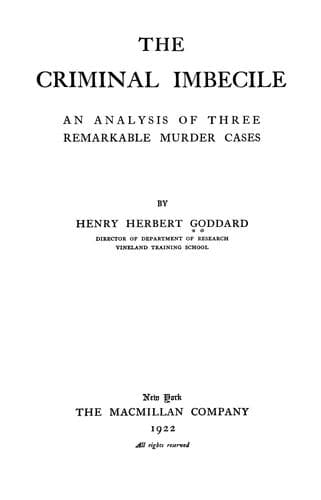
The Criminal Imbecile: An Analysis of Three Remarkable Murder CasesGoddard, Henry Herbert
Science
The Criminal Imbecile: An Analysis of Three Remarkable Murder Cases
Goddard, Henry Herbert
Crime -- Case studies; Murder -- Case studies; Offenders with mental disabilities -- Case studies
"The knife I stabbed her with was one that belonged to my father and I
took it home and put it in the pantry drawer.
"I left the wrench somewhere near where I hit her. When I hit her
first, she did not scream but moaned.
"She said she thought it was quite a ways and she did not see any
house.
"I was not afraid when I got home; I was just as happy as I ever was
and didn't think anything about it as I thought I had revenge.
"I make this statement voluntarily and under no fear or threat and
knowing the same may be used against me.
"JEAN GIANINI.
"Subscribed and sworn to before me this 28th day of March, 1914.
"FRED MOORE,
"_Justice of the Peace of Town of Russia_."
In its main points the confession must be accepted as true. To refuse to
accept it would be to admit at once without further proof that the boy
was crazy or an imbecile, since, if it were not true, it is inconceivable
that any normal person would claim to have done such a deed. It is
accepted then by all that Jean Gianini killed Lida Beecher on the night of
March 27th, 1914. There is no difference of opinion on that point. It is
now only a question of his responsibility.
We may now review the facts and see what is the evidence: first, that he
is an imbecile; second, that being an imbecile, he did not know the nature
and quality of his act and that it was wrong.
Is Jean Gianini an imbecile? What is an imbecile? We cannot expect to
agree upon the question of whether Jean is an imbecile until we agree upon
the definition of imbecile. There are various ways of designating this
type of individual. Imbecility, as used in law in this country, may be
defined as "the state of mental defect existing from birth or from an
early age, due to incomplete cerebral development, in consequence of which
the person affected is unable to perform his duties as a member of
society." The high-grade imbecile, such as the person under discussion,
feeble-minded as he is called in England, or the moron as we are coming to
call him in the United States, is one who is "capable of earning a living
under favorable circumstances, but is incapable from mental defect,
existing from birth or from an early age, (_a_) of competing on equal
terms with his normal fellows, or (_b_) of managing himself or his affairs
with ordinary prudence." These definitions were formulated by the Royal
College of Physicians of England, and accepted by the Royal Commission on
the Care and Control of the Feeble-minded.
Public-domain text, read in full here on John Shaqi.
Reviews
Reviews
No reviews yet
Be the first to share your thoughts on this work.
Join the Discussion
Join the discussion
Sign in to leave a comment or review.
Sign InorCreate an account