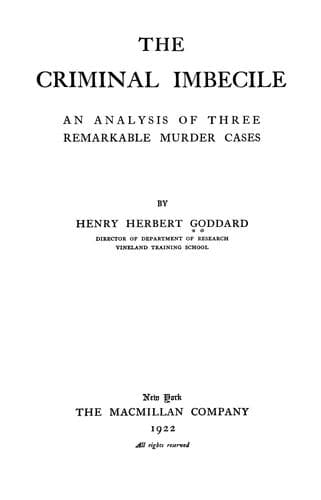
The Criminal Imbecile: An Analysis of Three Remarkable Murder CasesGoddard, Henry Herbert
Science
The Criminal Imbecile: An Analysis of Three Remarkable Murder Cases
Goddard, Henry Herbert
Crime -- Case studies; Murder -- Case studies; Offenders with mental disabilities -- Case studies
Defendant requests your Honor to charge that from the failure of the
commonwealth to call as witnesses Drs. Maybon and Palmer, who examined the
defendant, the jury may infer that they would have testified that the
defendant was a high-grade imbecile who was laboring under such defect of
reason as not to know the nature and quality of the act of which he is
charged in the indictment or not to know the act was wrong at the time it
was committed.
XL
Defendant requests your Honor to charge that from the failure of the
commonwealth to call as witnesses Drs. Maybon and Palmer, the jury may
infer that had they been called they would have testified unfavorably and
adversely to the commonwealth, especially in the absence of any
explanation made under oath as to why they were not called.
XLI
Defendant requests your Honor to charge that if the jury acquit the
defendant on the ground of insanity, in that event the jury should specify
in its verdict that it acquits him on the ground of insanity.
XLII
Defendant requests your Honor to charge that if the jury acquit the
defendant upon the ground of insanity, it will become the duty of the
Court to order him committed to a State Asylum.
XLIII
Defendant requests your Honor to charge that if the jury acquit the
defendant on the ground of insanity, in this case such insanity will mean
imbecility, and that as imbecility cannot be cured, it will become the
duty of the Court to order him committed to a State Asylum for the rest of
his actual life.
XLIV
Defendant requests your Honor to charge the jury that the denial of the
several motions made by defendant's counsel throughout the trial, and the
rulings of the Court upon objections, and refusals by the Court to charge
as requested, are not to be taken as any expression of opinion on the part
of the Court upon the facts of this case, but are only rulings upon the
law, about which the jury has nothing to do.
NOTE. Requests XXIV, XXV, XXVII, and XXVIII, the Court refused to charge.
INDEX
Abstract ideas, lack of, in morons, 98.
Actions after crime, Gianini, 25, 27.
Pennington, 50-52.
Tronson, 76-78.
Alcoholism, 110.
Barr, Dr. Martin W., statement of, 86.
Beecher, Miss, annoyed by Gianini, 23.
Binet tests, and school experience, 35, 38, 54.
use of, in Gianini case, 32-35.
in Pennington case, 53.
in Tronson case, 80.
Capital punishment, 101.
Cause of Gianini's condition, 39-41.
Causes of feeble-mindedness, 39.
"Charity" in Binet tests, 34.
Children, testimony of, 90.
actions of, 94.
suggestibility of, 63.
Code quoted, 128.
Colonization, 107.
Confession, Gianini, 4, 9, 10.
Pennington, 44, 53.
Tronson, 67-80.
characteristic of imbeciles, 16, 29.
childishness of Pennington's, 55, 56.
not necessarily true, 17.
why Gianini made a, 15.
Confessions compared, 83, 90-93.
Courtroom, conduct in, 30, 67, 92.
Coward, the imbecile, 23.
Cretinism, 40.
Public-domain text, read in full here on John Shaqi.
Reviews
Reviews
No reviews yet
Be the first to share your thoughts on this work.
Elsewhere in the archive
Join the Discussion
Join the discussion
Sign in to leave a comment or review.
Sign InorCreate an account