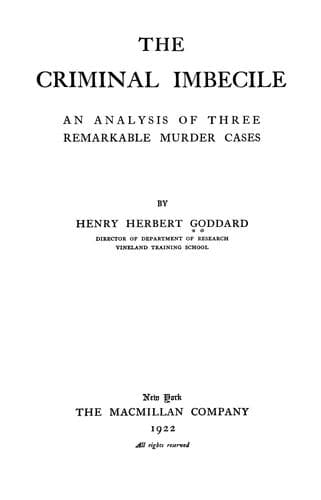
The Criminal Imbecile: An Analysis of Three Remarkable Murder CasesGoddard, Henry Herbert
Science
The Criminal Imbecile: An Analysis of Three Remarkable Murder Cases
Goddard, Henry Herbert
Crime -- Case studies; Murder -- Case studies; Offenders with mental disabilities -- Case studies
Defendant requests your Honor to charge the jury that if the commonwealth
have established merely a slight, trifling, and inconsequential motive for
the commission of the act charged in the indictment, they should regard it
as important and give it more consideration in connection with the
question of the defendant's mental condition.
XXXII
Defendant requests your Honor to charge the jury that the commission of
the crime charged in the indictment by a child of tender years from its
very nature raises the question of abnormality of the defendant's mind and
in the absence of clear, strong, and convincing evidence on the part of
the commonwealth, it must conclude that the defendant's mental condition
was such that he did not understand the wrongfulness of his act or
understand the nature and quality of his act.
XXXIII
Defendant requests your Honor to charge that evidence of the want of a
rational and reasonable motive on the part of the defendant for the
perpetration of the act charged in the indictment is to be considered by
the jury as strong corroboration of the fact of his mental
irresponsibility.
XXXIV
Defendant requests your Honor to charge that the perpetration of the act
charged in the indictment without any apparent motive or object, but
against every motive which would appear to be naturally influential with
the defendant, that they must at once inquire whether or not the defendant
was of sound mind and take into consideration with the other evidence of
this case that he was not of sound mind, the absence of sufficient motive
must lead them to conclude that he was of unsound mind and could not
distinguish between right and wrong or know the nature and quality of his
act.
XXXV
Defendant requests your Honor to charge that the absence of a clear and
convincing motive in itself is evidence of an unsound mind.
XXXVI
Defendant requests your Honor to charge that if the defendant acted
without any reasonable or rational motive or object, but against every
motive and object, which it would appear should have been influential with
him, that fact in itself raises a presumption that the defendant was of
such unsound mind that he could not distinguish between right and wrong or
know the nature or quality of his act.
XXXVII
Defendant requests your Honor to charge the jury that they have no right
to presume a motive from the mere commission of the crime and have no
right to speculate, guess, or surmise or supply any motive for the
commission of the act charged in the indictment.
XXXVIII
Defendant requests your Honor to charge that the failure of the
commonwealth to call as witnesses Drs. Maybon and Palmer, who made
examinations of the defendant, to testify as to his mental condition,
raises the inference that if they had been called as witnesses, they would
have testified adversely to the commonwealth in respect to the defendant's
mental condition.
XXXIX
Public-domain text, read in full here on John Shaqi.
Reviews
Reviews
No reviews yet
Be the first to share your thoughts on this work.
Elsewhere in the archive
Join the Discussion
Join the discussion
Sign in to leave a comment or review.
Sign InorCreate an account