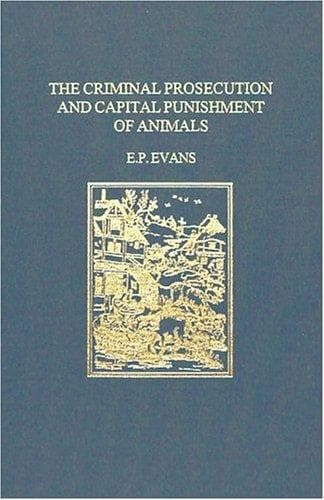
The Criminal Prosecution and Capital Punishment of AnimalsEvans, E. P. (Edward Payson)
History
The Criminal Prosecution and Capital Punishment of Animals
Evans, E. P. (Edward Payson)
Animals -- Law and legislation -- History; Animals, Prosecution and punishment of -- History; Trials -- Europe
In the covenant with Noah it was declared that human blood should be
required not only “at the hand of man,” but also “at the hand of every
beast;” and it was subsequently enacted, in accordance with this
fundamental principle, that “if an ox gore a man or a woman that they die,
then the ox shall be surely stoned, and his flesh shall not be eaten.” To
eat a creature which had become the peer of man in blood-guiltiness and in
judicial punishment, would savour of anthropophagy. This decision of
Jewish law-givers as to the use of the flesh of otherwise edible animals
condemned to death for crime has nearly always been followed. Thus when,
in 1553, several swine were executed for child-murder at Frankfort on the
Main, their carcasses, although doubtless as good pork as could be found
in the shambles, were thrown into the river. Usually, however, they were
buried under the gallows or in whatever spot was set apart for interring
the dead bodies of human criminals. At Ghent, however, in 1578, after
judicial sentence of death had been pronounced on a cow, she was
slaughtered and her flesh sold as butcher’s meat, half of the proceeds of
the sale being given as compensation to the injured party and the other
half to the city treasury for distribution among the poor; but her head
was struck off and stuck on a stake near the gallows, to indicate that she
had been capitally punished. The thrifty Flemings did not permit the moral
depravity to taint the material substance of the bovine culprit and impair
the excellence of the beef.
On the other hand, the Law Faculty of the University of Leipsic decided
that a cow, which had pushed a woman and thereby caused her death at
Machern in Saxony, July 20, 1621, should be taken to a secluded and
barren place and there killed and buried “unflayed.” In this case the
flesh of the homicidal animal was not to be eaten nor the hide converted
into leather. (_Vide_ Appendix S.)
Public-domain text, read in full here on John Shaqi.
Reviews
Reviews
No reviews yet
Be the first to share your thoughts on this work.
Elsewhere in the archive
Join the Discussion
Join the discussion
Sign in to leave a comment or review.
Sign InorCreate an account