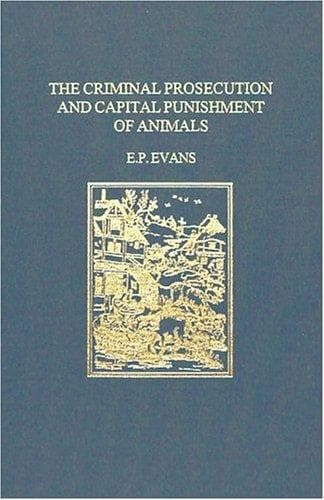
The Criminal Prosecution and Capital Punishment of AnimalsEvans, E. P. (Edward Payson)
History
The Criminal Prosecution and Capital Punishment of Animals
Evans, E. P. (Edward Payson)
Animals -- Law and legislation -- History; Animals, Prosecution and punishment of -- History; Trials -- Europe
Strictly speaking, the term ἄψῦχων should be applied only to an inanimate
object and not to the brute, which was more correctly called ἄφωνον
(dumb); but this distinction was not always observed either in common
parlance or in legal phraseology. The law on this point as formulated and
expounded by Plato (_De Leg._, IX. 12) was as follows: “If a draught
animal or any other beast kill a person, unless it be in a combat
authorized and instituted by the state, the kinsmen of the slain shall
prosecute the said homicide for murder, and the overseers of the public
lands (ἀγρονόμοι), as many as may be commissioned by the said kinsmen,
shall adjudicate upon the case and send the offender beyond the boundaries
of the country (ἐξορίζειν, exterminate in the literal and original sense
of the term). If a lifeless thing shall deprive a person of life, provided
it may not be a thunderbolt (κεραυνός) or other missile (βέλος) hurled by
a god, but an object which the said person may have run against or by
which he may have been struck and slain, then the kinsman immediate to the
deceased shall appoint the nearest neighbour as judge in order to purify
himself as well as his next of kin from blood-guiltiness, but the culprit
(τὸ ὄφλον) shall be put beyond the boundaries, in the same manner as if it
were an animal.” In the same section it is enacted that if a person be
found dead and the murderer be unknown, then proclamation shall be made by
a herald on the market-place forbidding the murderer to enter any
sanctuary or the land of the slain, and declaring that, if discovered, he
shall be put to death and his body be thrown unburied beyond the
boundaries of the country of the person killed. The object of these
measures was to appease the Erinnys or avenging spirit of the deceased,
and to avert the calamities which would otherwise be brought upon the
land, in accordance with the strict law of retribution demanding blood for
blood, no matter whether it may have been shed wilfully or accidentally.
[Cf. Æschylus, _Cho._, 395, where this law (νόμος) is clearly and strongly
affirmed.] The same superstitious feeling leads the hunters of many savage
tribes to beg pardon of bears and other wild animals for killing them and
to purify themselves by religious rites from the taint incurred by such an
act, the μίασμα of murder, as the Greeks called it.
Public-domain text, read in full here on John Shaqi.
Reviews
Reviews
No reviews yet
Be the first to share your thoughts on this work.
Elsewhere in the archive
Join the Discussion
Join the discussion
Sign in to leave a comment or review.
Sign InorCreate an account